

Buy or Rent a Dry Ice Machine: Which Option Is More Economical?
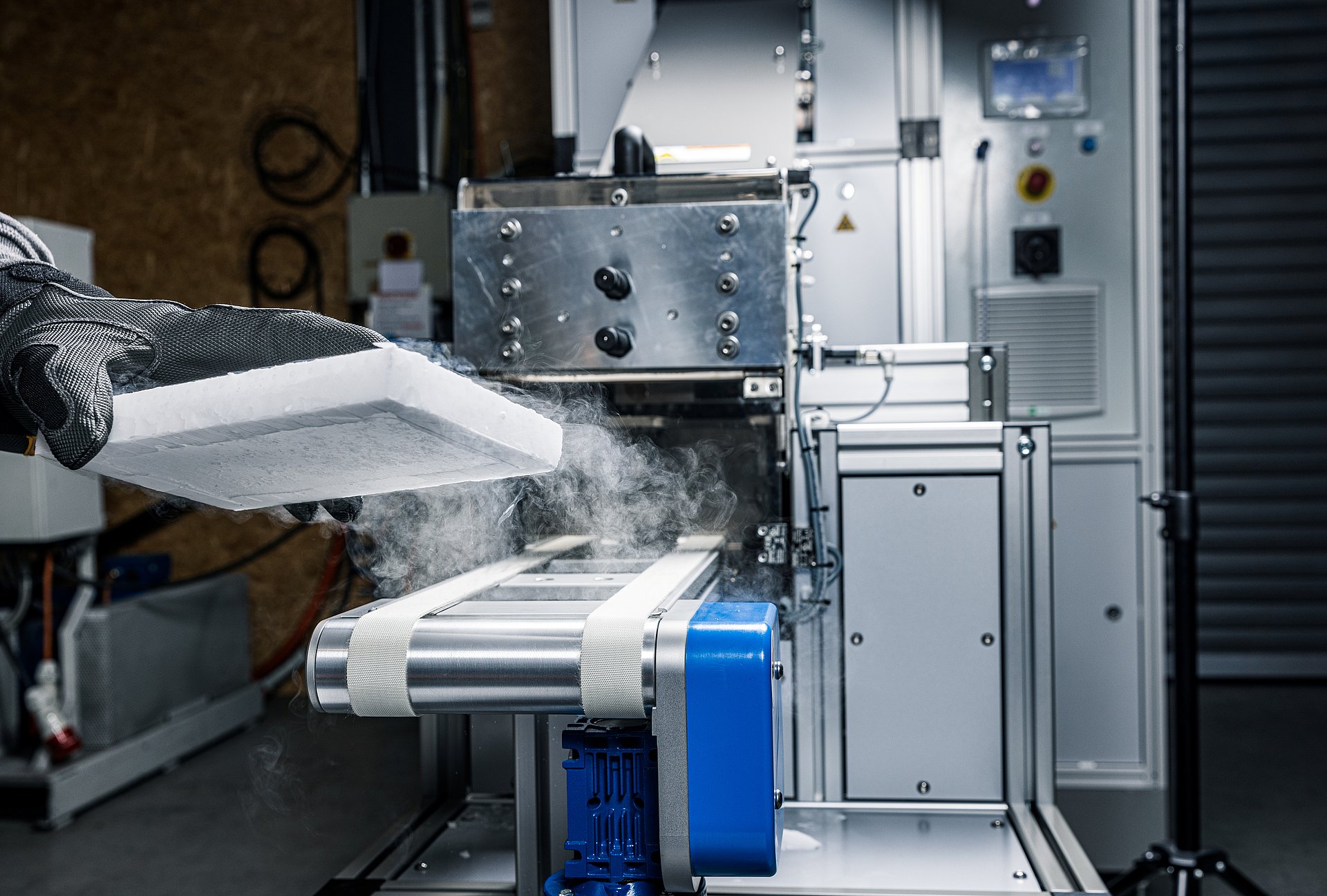
When In-House Dry Ice Production Makes Sense
Many companies initially source dry ice from external suppliers. For occasional applications, this is often sufficient. As demand increases, however, the requirements change: delivery times, transport costs and availability become more important. At the same time, dry ice can only be stored for a limited period due to natural sublimation and cannot be kept in stock like a conventional raw material.
In-house production therefore becomes particularly relevant when dry ice is needed regularly, at short notice or in predictable quantities. Companies can produce it fresh, reduce dependency on deliveries and avoid losses caused by long storage times.
Once in-house production makes sense in principle, the next step is to decide how this production should be organised and financed.
Buying a Dry Ice Machine: Full Control and Full Responsibility
Buying a dry ice machine is primarily an ownership model. The company integrates the system into its own infrastructure for the long term and retains full control over production. At the same time, it also assumes responsibility for ongoing operation. This includes maintenance, service coordination, spare parts and ensuring operational readiness.
These tasks can be managed internally if the necessary technical expertise, personnel resources and clear responsibilities are available. If these conditions are not in place, however, additional organisational effort arises. This effort is just as relevant in the economic assessment as the purchase price itself.
This is precisely why many companies take a closer look at how much technical responsibility they want to handle themselves. At the same time, technical teams in many operations are already heavily occupied.
This shifts the question. It is not only about the initial purchase price. The decisive factor is which operating model organises service, maintenance, costs and internal workload in a way that keeps dry ice supply reliable over the long term.
A Shift in Industry: Why Rental Models Are Gaining Importance
For this reason, rental, service and contracting models are becoming more important in many industrial sectors. Companies want to use technical infrastructure without having to cover every task related to operation, maintenance and service internally.
Predictable costs, clearly defined responsibilities and reduced organisational effort are becoming important decision criteria.
For dry ice production, this approach is particularly logical. The value does not come from owning the machine alone, but from reliably available dry ice production with predictable costs and minimal internal coordination effort.
Renting a Dry Ice Machine: In-House Production Without a High Initial Investment
This shift is also visible in dry ice machines. Companies still want to produce dry ice themselves, but they are assessing more carefully whether they need to buy a machine and manage it entirely on their own. Rental follows a different approach: companies use the benefits of in-house production without having to purchase the equipment. Instead of a high initial investment, the result is a contractually defined cost model with a fixed monthly price that can be integrated more easily into ongoing budgets.
In addition, a rental model often includes more than the use of the machine itself. Depending on the configuration, service, maintenance, spare parts and additional services related to CO₂ supply can be part of the scope. For companies, this means less organisational effort, more predictable costs and higher operational reliability in daily use.
A concrete example is ASCO Carefree, ASCO’s rental model. Companies rent a dry ice machine at a fixed monthly price. Service and spare parts are included. CO₂ delivery and level monitoring of the storage tank can be added as optional services.
This creates a model that combines access to in-house dry ice production with clearly defined services. For companies, this makes not only the machine more predictable, but the entire operation around dry ice availability.
Buy or Rent: Which Solution Is More Economical?
Looking only at the purchase price or rental fee is not enough for an economic assessment. The decisive factor is which cost items arise over the entire period of use and how predictable they are. In addition to the machine itself, these include maintenance, spare parts, internal support, CO₂ supply, storage and possible production interruptions.
A compact comparison helps make the decision more tangible. However, there is no single cost calculation that applies to every situation. Economic viability differs significantly depending on the machine, company, period of use, demand pattern and internal resources. The table therefore does not show exact figures, but typical assessment factors.
| Purchase | Rental | |
| Initial investment | usually higher | usually lower |
| Cost structure | investment plus individual ongoing costs | recurring contractual costs |
| Service and maintenance | to be arranged separately | included in the model |
| Capital commitment | higher | lower |
| Internal responsibility | more comprehensive | reduced depending on the scope of services |
| Cost predictability | depends on maintenance and repairs | more predictable through fixed services |
The table makes one point clear: purchase and rental cannot be assessed in general terms. With purchase, stable demand patterns, available investment capital, internal technical resources and the desire for ownership are more important. With rental, lower capital commitment, contractually defined services and a cost structure that is often easier to plan are the main factors.
Conclusion: The Best Decision Is Not Just About the Machine
The question “rent or buy a dry ice machine?” does not start with the price of the machine, but with operational demand. How regularly is dry ice required? How critical is availability? Which technical resources are available internally? And how should investment, service responsibility and ongoing costs be distributed? Only this overall view shows whether purchase or rental is the more economical fit. There is no universally correct solution. ASCO supports companies in evaluating these factors in a structured way and choosing the right model for their dry ice production.
FAQ

When does in-house dry ice production make sense?
In-house dry ice production is particularly worthwhile when dry ice is required regularly, at short notice or in predictable quantities. Companies reduce dependency on deliveries and can produce fresh dry ice according to actual demand.
Is it more economical to buy or rent a dry ice machine?
That depends on demand, period of use, internal resources and the desired cost structure. Buying can make sense for long-term stable use, while rental enables a lower initial investment and more predictable ongoing costs.
What costs arise when buying a dry ice machine?
In addition to the purchase price, further costs may arise depending on operation, including maintenance, service, spare parts, internal support, CO₂ supply and storage. These factors should be considered in the economic assessment.
What is included when renting a dry ice machine?
The exact scope of services depends on the respective rental model. With ASCO Carefree, service and spare parts are included in the fixed monthly price; CO₂ delivery and level monitoring of the storage tank can be added as optional services.
What are the advantages of a rental model for dry ice machines?
A rental model reduces capital commitment, simplifies cost planning and relieves internal technical teams. This is especially relevant for companies that want to produce dry ice in-house while keeping operation, service and maintenance clearly defined.


 +41 71 466 80 80
 info@ascoco2.com
 Newsletter
 LinkedIn