

CarbAlpin: "We see significant growth opportunities in the online grocery sector"
Tell us a bit about CarbAlpin. As well as food-grade and industrial gases, you also supply dry ice. How do these two business areas compare in terms of size?
At present, dry ice sales account for 88% of turnover, whilst industrial gases make up just 12%. An interesting aspect is that, unlike most dry ice production companies, CarbAlpin did not start out selling industrial gases, but initially focused on the production of dry ice.
Due to our high consumption of CO₂, we have become a major player in the Italian CO₂ market. We are now venturing more and more into the field of gas filling for technical and food-grade gases. This step is particularly important for our company, as the massive price fluctuations and supply bottlenecks in the CO₂ market have made it clear to us how important it is to have a broad base and to be able to diversify our products. Nevertheless, dry ice remains our core business, and we will continue to focus on it.
What are your main customer sectors and what is your best-selling dry ice product?
Our company is based in South Tyrol and is surrounded by around 130 wineries, which mainly produce white wine. It was therefore no coincidence that we specialised in supplying wineries, particularly for winemaking using cold maceration. Thanks to our proximity and high production speed, we can respond optimally to the wineries’ needs and have become an important partner for them.
As wine production is concentrated into just a few months of the year, it is important for us to ensure stable utilisation of our production machinery. We have achieved this by acquiring new customers in the cold chain logistics sector. In 2021, the volume of dry ice sales in cold chain logistics exceeded that of the wine production segment for the first time and is now by far our most important sector. This means that demand for compressed dry ice discs has made them our best-selling product, replacing the previous standard 3 mm pellets.
You produce your own dry ice using ASCO pelletisers. What is the difference, or rather the advantages, of dry ice compared to other coolants?
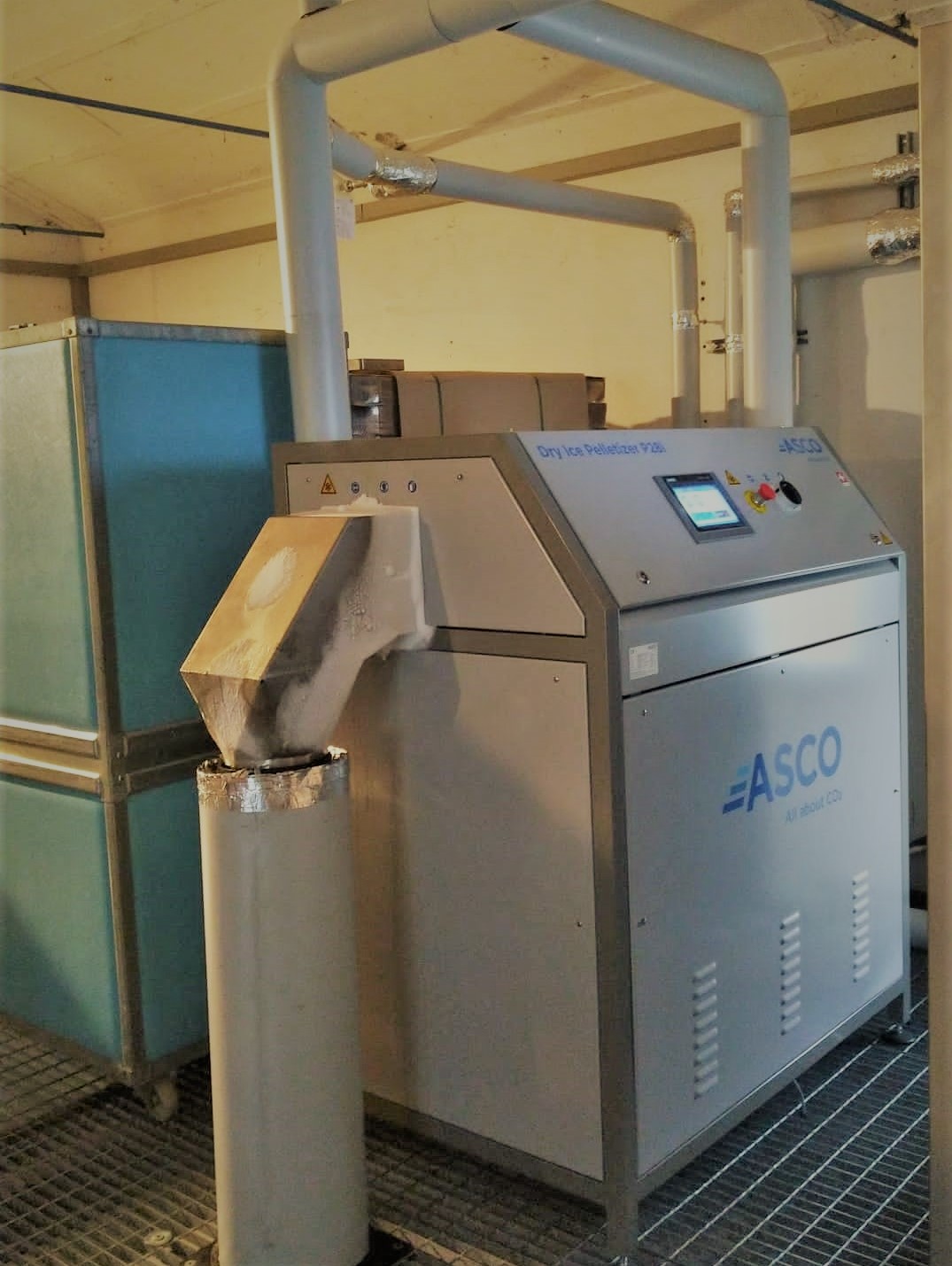
Dry ice offers several distinct advantages over other coolants. It leaves no residue or moisture, is extremely cold and enables rapid cooling. Furthermore, it sublimates without melting, which makes handling and disposal easier. These properties make dry ice ideal for applications requiring a dry environment, such as the food and pharmaceutical industries. For these reasons, we produce our own dry ice using ASCO pelletisers.
Our decision to use dry ice production machines from ASCO is based on our focus on quality and our need for reliable production. We cannot afford any production downtime, which is why we rely on ASCO’s proven quality and performance. Furthermore, ASCO offers excellent value for money, which is of great importance to our company.
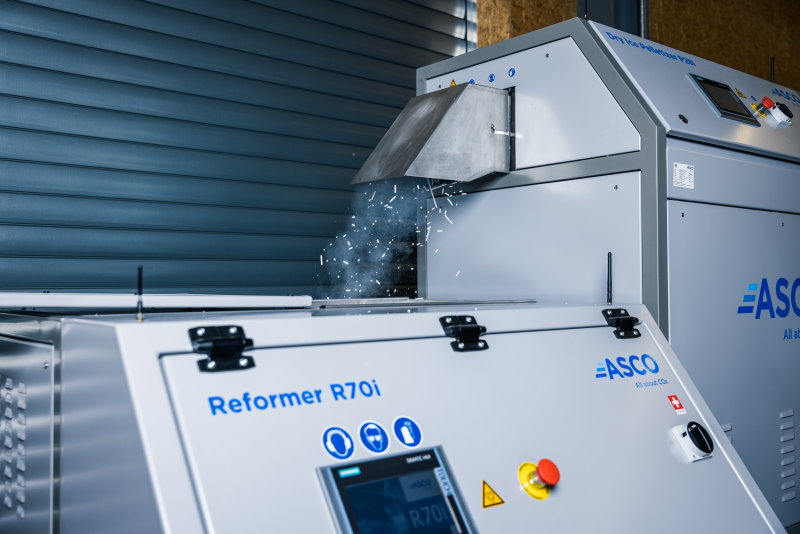
With your ASCO reformer, you can produce dry ice discs and blocks from dry ice pellets. What are the applications for dry ice discs and blocks?
We primarily use our reformer to produce pressed dry ice discs, which are mainly used in cold chain logistics and food e-commerce. We see food e-commerce in particular as an industry with great potential and are committed to successfully introducing our dry ice products in this sector. By using compressed dry ice discs, we can ensure efficient and reliable cooling for the growing online food retail sector.
CarbAlpin has expanded its dry ice delivery business in recent years. When and why did you decide to produce dry ice?
Originally, we were interested in dry ice blasting technology and carried out initial machine tests. However, we realised that it is difficult to source fresh dry ice in our region. When we recognised the growing market for dry ice production, we decided not to pursue dry ice cleaning any further. We wanted to avoid entering into direct competition with our future customers and ending up in a conflict of interest.
This strategy has paid off for us, as we now have numerous customers who offer dry ice cleaning services. Through this collaboration, we complement each other perfectly by referring customers to one another and benefiting from the different services on offer.
“Carbon capture” is a key focus in many industries. What are your CO₂ sources, and are you considering recovery solutions to maximise your conversion rate from liquid CO₂ to dry ice?
As we know the CO₂ market well, we recognised the emerging instability in supply and delivery issues several years ago and responded accordingly. We are aware that current developments are putting pressure on smaller dry ice production companies, as they are finding it difficult to produce and sell dry ice profitably due to fluctuating market prices. For this reason, we opted for a recovery system some time ago. We use recovery solutions to maximise our conversion rate from liquid CO₂ to dry ice. By recovering CO₂, we can use resources more efficiently whilst reducing our environmental impact.
Investing in a recovery system enables us to recover CO₂ from various sources and use it for dry ice production. This allows us to reduce our reliance on external CO₂ supplies and ensure a stable supply. Furthermore, this contributes to more sustainable and environmentally friendly production, as we reuse CO₂ rather than treating it as a waste product.
Maximising our conversion rate of liquid CO₂ into dry ice is a key priority for us in order to utilise our production capacity efficiently and remain economically viable. By implementing recovery solutions, we can achieve this goal whilst simultaneously reducing our carbon footprint.
What are CarbAlpin’s next goals? Are there any new areas or services where you see potential for new business? Our next goals at CarbAlpin are to gradually expand our activities in gas filling. With the acquisition of the ASCO CO₂ cylinder filling plant LH900, we have already taken the first step in this direction and we do not intend to stop there. We see potential for new business areas and services in gas filling, and we will continue to explore opportunities to diversify our business and capitalise on new market opportunities. In doing so, we will ensure that we maintain our high quality standards and meet the needs of our customers.
 General Question
 +41 71 466 80 80
 info@ascoco2.com
 Newsletter
 LinkedIn