

In-house production or purchasing? When is it really worth producing dry ice in-house?
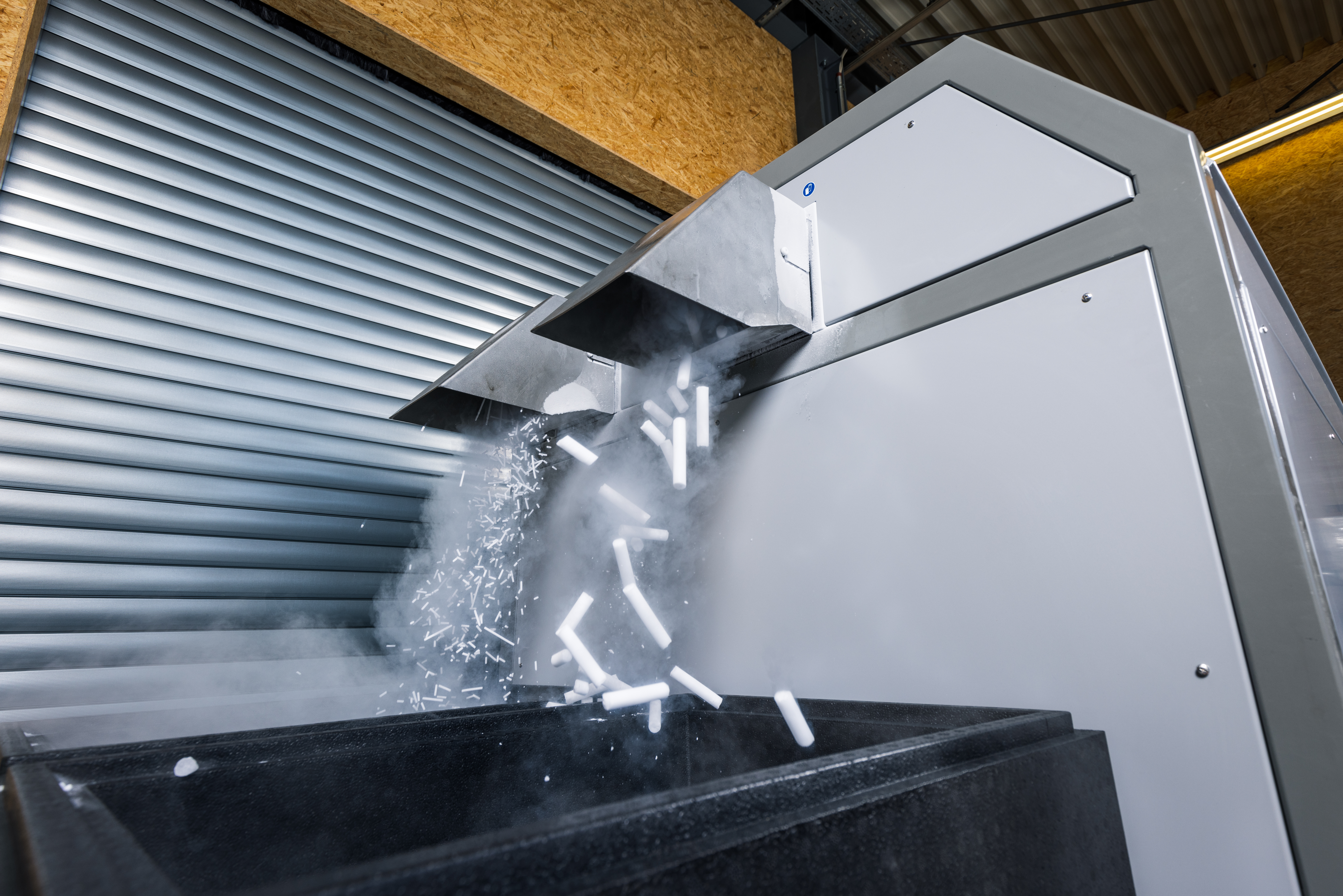
Dry ice in industrial applications: a critical production factor
In many industrial sectors, dry ice is far more than just a consumable. In dry ice blasting, it enables gentle, residue-free cleaning; in logistics, it provides reliable cooling without electricity; and in production, it supports temperature-critical processes.
If dry ice is unavailable at short notice, this can have an immediate impact on production capacity. This is precisely where the strategic consideration begins: How dependent is my company on a continuous supply of dry ice?
Purchasing dry ice: advantages and limitations
For many companies, purchasing dry ice is the first step towards using it. It requires no investment in machinery, maintenance or CO₂ infrastructure and offers a high degree of flexibility for occasional or fluctuating demand. External procurement makes economic sense, particularly for small quantities or sporadic use.
However, purchasing dry ice also comes with limitations. Dry ice sublimates continuously, which limits its shelf life and transport time. Delivery delays, minimum order quantities or fluctuating prices can complicate planning. As consumption rises, external procurement quickly becomes cost-intensive – especially when dry ice is required regularly and in larger quantities.
In-house dry ice production – greater control and independence
In-house dry ice production shifts control entirely to your own company. Dry ice is produced on demand, exactly when it is needed, and in the appropriate form – such as pellets or blocks. This significantly reduces losses due to sublimation.
A key advantage lies in security of supply. Production processes are no longer dependent on external dry ice suppliers, meaning companies remain able to act even in the event of short-term demand. The only requirement is the procurement of LCO₂ as a raw material, which is, however, easily planned and does not in any way restrict the flexibility of in-house production. At the same time, in-house production offers a high degree of flexibility: production volumes can be adjusted at short notice without having to take delivery times for ready-made dry ice into account.

Cost analysis: When does in-house production become cost-effective?
Whether in-house dry ice production is economically viable depends heavily on consumption volumes. Whilst purchasing small quantities remains cheaper, the break-even point shifts significantly towards in-house production as demand increases.
In addition to the pure costs of dry ice, indirect factors also play a role: lower logistics costs, fewer production interruptions, more stable prices and better predictability. In the long term, companies also benefit from being able to make their processes more independent and efficient. Particularly with regular, daily use of dry ice, it is evident that investments in in-house production facilities often pay for themselves more quickly than expected.
Flexibility as a strategic competitive advantage
In many industries, flexibility is a key success factor. In-house dry ice production enables companies to respond immediately to production peaks, short-notice orders or unplanned cleaning requirements. In contrast, external procurement usually requires forward planning. Changes in demand can only be accommodated to a limited extent. Companies with their own production facilities thus gain not only operational flexibility but also a clear competitive advantage.
Security of supply and risk minimisation
Recent years have shown just how vulnerable supply chains can be. Shortages of CO₂ and dry ice have led to production stoppages in many sectors. In-house dry ice production significantly reduces this risk.
Companies thereby secure a constant supply of dry ice whilst simultaneously increasing their resilience to market fluctuations, supply bottlenecks or price rises. This security of supply is a factor that should not be underestimated, particularly for critical applications.
Carefree: Dry ice production as a smart alternative to investment
For companies that require dry ice on a regular basis but wish to assess the investment in their own production plant first, the Carefree model offers an attractive alternative. Instead of purchasing the machine, companies can use a dry ice production plant for a fixed monthly rental fee – including service, maintenance and optional CO₂ supply.
This model combines the advantages of in-house production with maximum flexibility: dry ice can be produced as and when required, without incurring high investment costs. At the same time, the company remains independent of external supply chains and can respond to production peaks at short notice. Carefree thus offers a smart, predictable solution for anyone wishing to safeguard their processes without having to invest in purchasing a plant straight away.
Conclusion: A strategic decision with long-term implications
The question “in-house production or purchasing?” is less a matter of cost and more a strategic decision. Companies with regular, high dry ice requirements clearly benefit from in-house production – through lower costs per kilogram, maximum flexibility and high supply security.
For smaller or irregular applications, purchasing remains a sensible solution. The key is to analyse one’s own requirements realistically and to consider not only short-term costs but also long-term efficiency, security and independence. Anyone who recognises dry ice as a critical production factor will quickly realise that in-house dry ice production is not only worthwhile – but can be a genuine competitive advantage.
 General Question
 +41 71 466 80 80
 info@ascoco2.com
 Newsletter
 LinkedIn