

Dry Ice Blasting vs. Conventional Cleaning Methods: Industrial Cleaning Compared
Requirements for Modern Industrial Cleaning Methods
Industrial cleaning processes today face significantly higher requirements than just a few years ago. In addition to pure cleaning performance, factors such as equipment availability, material protection, process reliability and environmental aspects are becoming increasingly important.
In practice, this means that a cleaning method must not only remove contamination reliably, but also integrate into the production process with as little downtime as possible. At the same time, it must avoid unnecessary stress on materials and should not create additional residues or require extensive post-processing.
This is exactly where the differences between conventional methods and newer technologies such as dry ice blasting become particularly clear.
Overview: Cleaning Methods Compared
The following overview compares common industrial cleaning methods across key evaluation criteria. The assessment uses a scale from 1 (weak) to 5 (very good) and shows how the individual methods perform in terms of cleaning effect, material protection, process integration and other relevant factors.
The table provides an initial orientation before the methods are examined in detail below.
| Dry Ice Blasting | High Pressure / Wet | Chemical Cleaning | Abrasive Blasting | Manual Cleaning | |
| Cleaning Effect | 4 | 3 | 4 | 5 | 2 |
| Material Protection | 5 | 3 | 3 | 1 | 3 |
| Redidues / Post-Processing | 5 | 2 | 2 | 1 | 3 |
| Downtime | 5 | 2 | 2 | 2 | 1 |
| Occupational Safety | 3 | 3 | 2 | 2 | 3 |
| Environmental Aspects | 4 | 2 | 2 | 2 | 3 |
Dry Ice Blasting
Cleaning principle
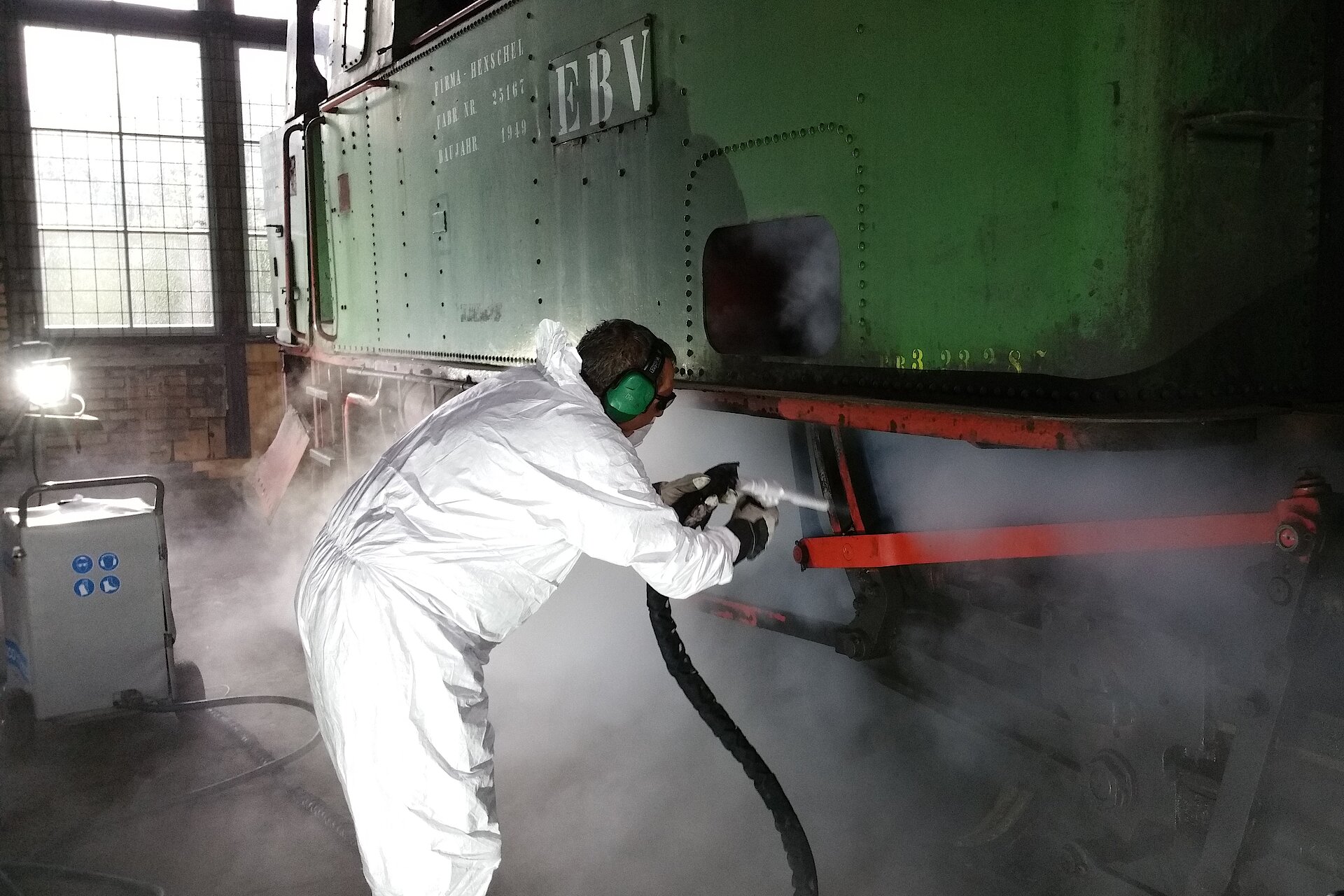
Dry ice blasting is based on the combination of thermal shock, kinetic energy and sublimation. When the CO₂ pellets hit the surface, contamination becomes brittle, separates from the surface and is removed by the volume expansion of the CO₂.
Decisive point: the blasting medium disappears completely. No additional residue is created.
Cleaning performance
In practice, the process removes a wide range of contaminants – from greases and oils to resins, paints and production residues. Particularly relevant is the ability to clean equipment and moulds directly in their installed state.
Material behaviour
Because CO₂ pellets are comparatively soft and sublimate on impact, the material itself is not removed; only the contamination is detached. Surface structure and function remain intact.
This has a direct effect on maintenance intervals and the service life of equipment.
Process integration
A key advantage is the possibility of cleaning equipment in its installed state and, in some cases, even while still warm. This eliminates dismantling, drying and additional process steps. Downtime can therefore be significantly reduced.
Environmental and safety aspects
The process uses no water and no chemical cleaning agents. It produces no wastewater and no additional blasting media residues. The CO₂ used generally comes from industrial by-products and is therefore recycled.
Noise emissions and the handling of CO₂ in enclosed spaces must be considered, which requires adequate ventilation.
High-Pressure and Wet Cleaning
Cleaning principle
Wet cleaning uses water or steam at high pressure to remove contamination mechanically. Cleaning agents are often added as well.
Cleaning performance
The method is effective for loose dirt and surface contamination. However, it reaches its limits with strongly adhering, greasy or burnt-on residues, or requires additional chemicals.
Material behaviour
High pressure and moisture can put stress on surfaces. There is also a risk of water entering sensitive areas, where it can cause corrosion or functional problems.
Process integration
A central disadvantage is the drying effort. After cleaning, equipment often has to remain out of operation until residual moisture has been removed. This extends maintenance cycles.
Environmental and safety aspects
Water consumption is high, and the resulting wastewater must be treated accordingly. In addition, wet work areas create a slipping hazard
Chemical Cleaning
Cleaning principle
Chemical cleaning agents target specific types of contamination, such as grease, limescale or organic residues. Their effect is based on chemical reactions.
Cleaning performance
The method is highly effective when the right cleaner is matched to the specific contamination. In practice, however, several steps are often necessary, including contact times and rinsing.
Material behaviour
Depending on their composition, chemicals can attack materials. Seals, plastics or metals may react sensitively, which can lead to long-term damage.
Process integration
The use of chemicals is often time-consuming. Contact times, rinsing and drying extend downtime and make the process more complex.
Environmental and safety aspects
Handling chemical substances requires protective measures, storage concepts and disposal solutions. Residues must be removed completely to ensure process reliability.
Abrasive Blasting
Cleaning principle
In abrasive blasting, solid particles such as sand, glass or plastic granulate are propelled onto the surface at high speed and mechanically remove material.
Cleaning performance
The method is highly powerful and reliably removes heavy coatings, rust or stubborn deposits.
Material behaviour
The major disadvantage is material removal. Surfaces are deliberately altered or damaged, which is undesirable in many applications.
Process integration
Abrasive blasting usually requires sealed-off areas and extensive post-processing because blasting media residues must be removed.
Environmental and safety aspects
Dust generation, noise and the handling of blasting media place high demands on occupational safety and environmental management.

Manual Cleaning
Cleaning principle
Cleaning is carried out manually by brushing, scraping or wiping. The method is flexible and requires only limited technical infrastructure.
Cleaning performance
Quality depends heavily on execution. Consistent and reproducible results are difficult to achieve, especially on large equipment.
Material behaviour
Depending on force and tool selection, damage may occur. At the same time, the method is often not effective enough for stubborn contamination.
Process integration
The time required is high, and cleaning is labour-intensive. This results in long downtimes.
Environmental and safety aspects
Ergonomic strain, physical effort and potential injury risks are central considerations.
Comparison and Assessment
A direct comparison reveals a clear pattern: conventional methods are each designed for specific requirements, but they come with inherent disadvantages. Moisture, chemical residues, material stress or long downtimes rarely occur in isolation; they often appear in combination.
In practice, this combination leads to increased coordination effort. Cleaning processes must be planned, post-processed and often supplemented with additional measures – such as drying, rinsing or protecting sensitive components. This not only creates longer downtimes, but also adds uncertainty to process stability.
Dry ice blasting addresses precisely this interface. The method combines several advantages that conventional methods usually offer only individually: dry cleaning, low material stress and direct integration into existing equipment and maintenance processes.
This means in practical terms:
Less post-processing, reduced downtime and overall more stable production.
Conclusion
Dry ice blasting is not a universal solution for every cleaning task. Abrasive methods remain relevant, especially where severe corrosion or targeted material removal is required.
Its strength lies in applications where several requirements must be met at the same time: thorough cleaning, minimal downtime and protection of equipment.
In such scenarios, dry ice blasting develops from an alternative method into a strategic tool for industrial maintenance.


 +41 71 466 80 80
 info@ascoco2.com
 Newsletter
 LinkedIn