

HÜTTENES-ALBERTUS and ASCO are setting new standards for mould cleaning in foundries
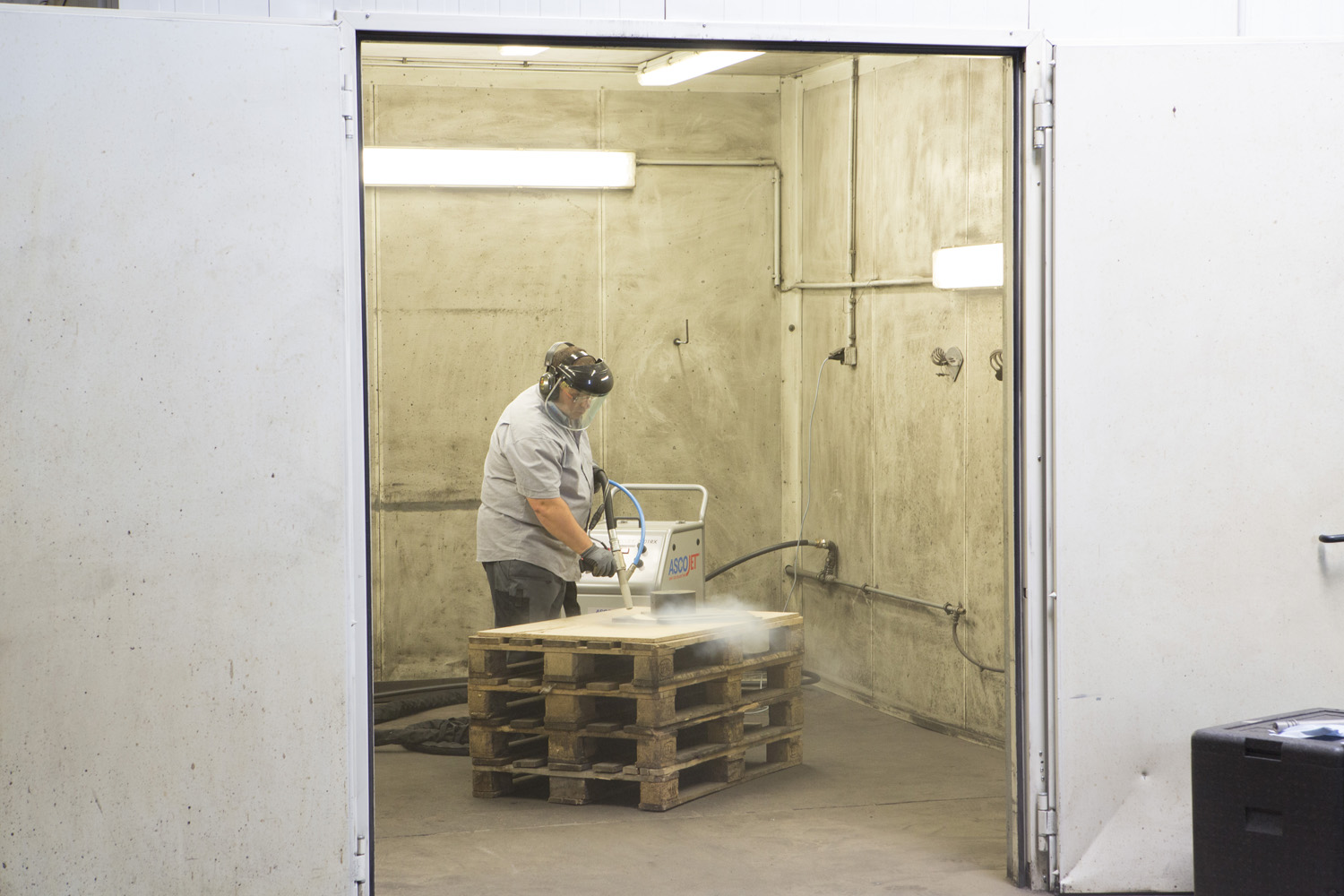
Mould and tool cleaning is of the utmost importance in foundries. In particular, ensuring the optimal cleaning of moulds and core boxes is a top priority, as this not only improves quality but also helps to optimise productivity and reduce costs. With its ASCOJET dry ice blasting system, ASCO KOHLENSÄURE AG specialises in introducing and optimising dry ice cleaning in foundries by offering bespoke comprehensive solutions. HÜTTENES-ALBERTUS GmbH also consistently tailors its products to ensure they are suitable for practical application, working in close collaboration with foundries.
Through open dialogue with foundries, both companies have established that there is currently no efficient comprehensive solution for the partial or complete removal of mould release agents from casting moulds. The current situation in foundries’ production facilities using gravity die casting is such that the top coatings on casting moulds must be thoroughly removed, sometimes several times a day. In addition, regular removal of the base coating is required, as well as occasional roughening of the moulds, which is very important for the coating to adhere. The removal of the top coat usually poses no problems whatsoever for pure dry ice blasting and has been carried out efficiently in countless foundries for years. However, the pure dry ice blasting process is only of limited suitability for removing the base coat or for the roughening process, as the application takes too long or the desired effect cannot be achieved for physical reasons. Pure abrasive blasting with sand or glass beads is too aggressive and would damage the surfaces of the moulds in the long term. Added to this is the high level of contamination resulting from significant secondary pollution during a purely abrasive blasting process.
Reason enough for both companies to combine their expertise in order to offer the end customer an optimal overall solution. The division of tasks is as follows: HÜTTENES-ALBERTUS is working on a special coating formulation for smoothing porous moulded part surfaces. For this purpose, finely ground refractory to highly refractory materials are used as the base material. The coating layer insulates the substrate – i.e. the moulds – and protects against thermal stress caused by the molten metal. However, foundry customers are now to be supplied not only with high-quality coatings, but also with a cleaning method perfectly tailored to them. This is where ASCO comes into play, as the recently launched ASCOJET Combi blaster 1708 can close precisely this gap in the cleaning process.
The new ASCOJET blasting unit offers the ideal combination of gentle cleaning with dry ice pellets and the additional, abrasive effect of a carefully selected additive. Udo Hinze, ASCO Regional Sales Manager for dry ice technology in Northern and Eastern Germany, explains the advantages of the ASCOJET Combi blaster 1708 as follows: “Depending on the application requirements, the additive can be flexibly mixed into the dry ice stream. Even during combination blasting, the cooling properties of the dry ice provide optimum material protection, whilst the supportive, abrasive effect of the additive effectively removes even stubborn dirt and deposits such as the base coat. Furthermore, moulds can be roughened in such a way that the subsequent, newly applied coating adheres perfectly.” Hinze also points out the low consumption of blasting media and the associated minimal dust formation, which results in almost no secondary contamination. The machine’s higher cleaning performance also allows it to operate with less compressed air, resulting in a significant reduction in noise emissions.
Another unbeatable advantage of all ASCOJET blasting machines: the process can be carried out directly on the installed, hot moulds, which means production can resume immediately after cleaning and the process can thus be easily integrated into the workflow. This eliminates costly production downtime and quality and process reliability can be improved with minimal effort.
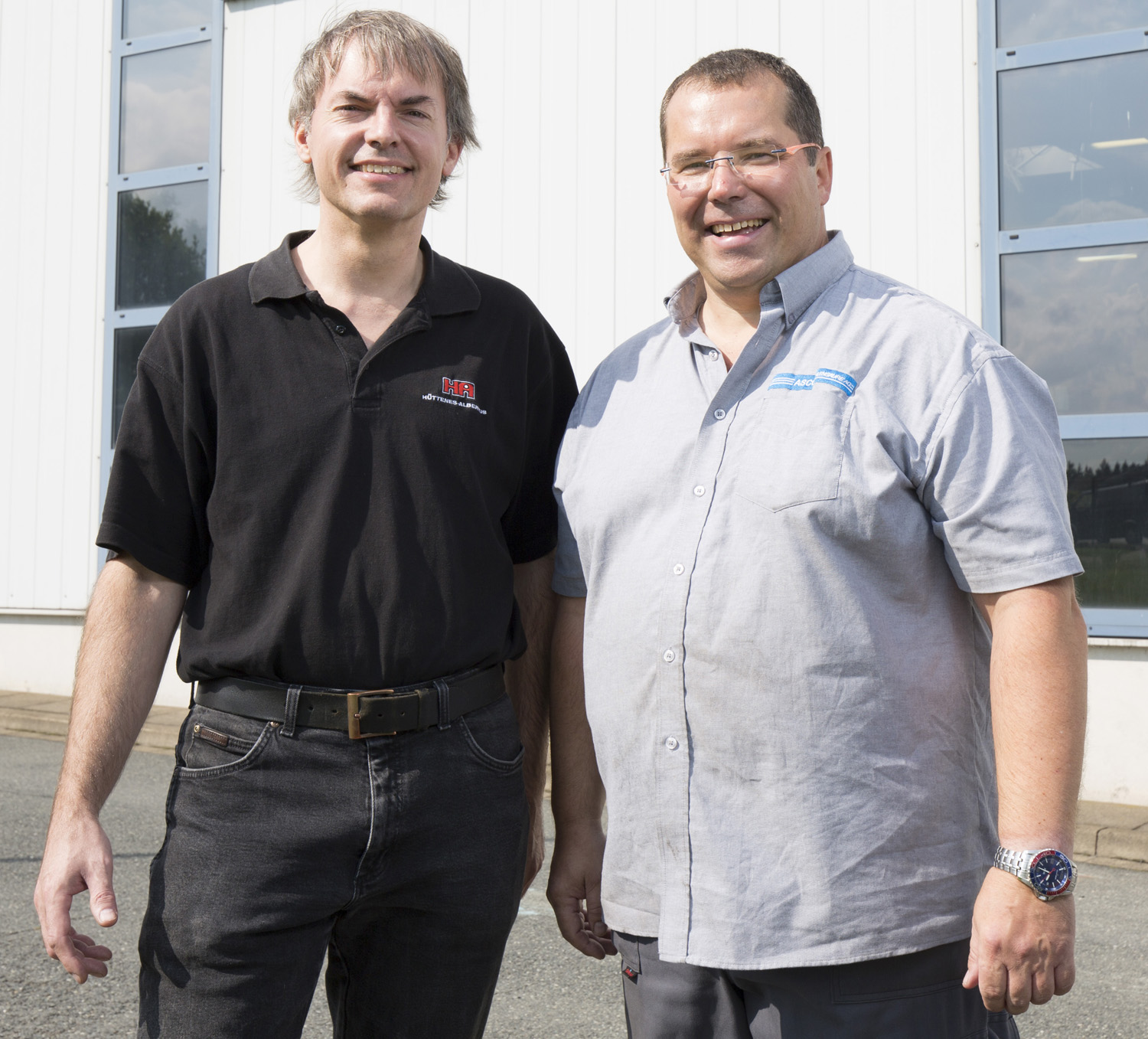
Marco Pellegrino, Managing Director at ASCO, recognises the unique nature of such a profitable collaboration: “Both HÜTTENES-ALBERTUS and ASCO bring extensive knowledge, expertise and experience to the broad field of dry ice blasting in foundries. Our products and application processes are optimally coordinated through regular test trials. For us as a supplier, it is of the utmost importance to maintain direct contact with the customer and not to develop products that miss the mark. The market launch of the ASCOJET Combi Blaster 1708 proves once again that ASCO focuses on the needs of its customers – in this case, foundries – and works in a solution-oriented manner. The same applies to HÜTTENES-ALBERTUS, which, with the development of an optimally formulated coating for our ASCOJET dry ice blasting process, will set new standards in terms of efficiency in mould cleaning.”
Heinz-Gilbert Klussmann, Product Manager for Release Agents / Non-Ferrous Metal Casting at HÜTTENES-ALBERTUS, explains why the collaboration with ASCO is already bearing fruit: “In close consultation with foundries, we consistently tailor our products to existing market needs. In doing so, we further develop tried-and-tested products, but also break new ground. It is precisely for these new paths that a reliable partner is needed. For us, ASCO is that partner. As a full-service provider for all things CO₂ and dry ice, dry ice blasting at ASCO is embedded within a comprehensive CO₂ framework. ASCO always works directly and straightforwardly with us to find the best solution. This best solution is then passed on to our customers.”
Joint test trials are currently underway to specifically define the optimal parameters regarding blasting pressure, dry ice quantity and abrasive quantity for the removal of the new sizing structure using the ASCOJET Combi blaster 1708. The possibility of ‘repairing’ surface coatings by cleaning with fine dry ice particles is also to be tested. This involves the partial removal of structures that are coming loose, without having to remove the entire coating. In this way, foundries can be offered a complete package comprising application technology and coating composition in future.
 General Question
 +41 71 466 80 80
 info@ascoco2.com
 Newsletter
 LinkedIn