

"Lower dry ice costs and reduced CO₂ emissions thanks to ASCO CO₂ recovery systems"
ASCO: Mr Schwinn, could you explain how the ASCO RRSi CO₂ recovery system works?
Schwinn: In any dry ice production process without recovery, the conversion rate of LCO₂ (= ‘liquid CO₂’) into dry ice is, for physical reasons, only around 40–45%. This is a result of the manufacturing process. In other words, 55–60% of the CO₂ is lost to the atmosphere. With an ASCO CO₂ recovery system (RRSi), the majority of the lost CO₂ is captured and returned to the CO₂ tank to make it usable again. This ultimately results in a conversion rate of 90–95% for the customer.
1. The CO₂ buffer tank: Stores the recirculated CO₂ (gaseous) from dry ice production at a slightly elevated ambient pressure.
2. The CO₂ compressor: The recovered CO₂ (gaseous) is compressed
to approx. 18–20 bar. 3. The CO₂ condenser: Condenses the compressed CO₂ gas using a refrigeration cycle. The re-condensed CO₂ is then returned to the storage tank for liquid CO₂ to be reused in dry ice production.
4. The control system: The central control system automatically monitors the entire process.
Despite the unchanged process in our new ASCO RRSi systems, an increase in value has been achieved through more efficient drives and the forward-looking R449A refrigerant for the refrigeration compressor. This translates to approximately 10% energy savings in the refrigeration process compared to previous systems.
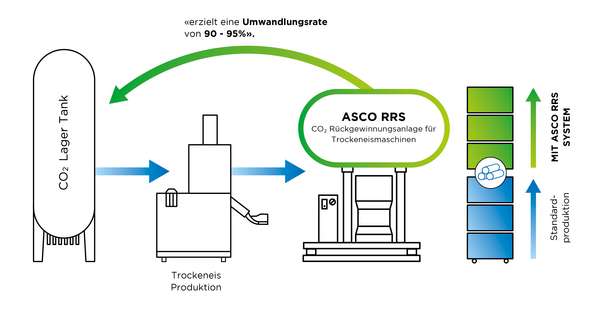
Fig. 1: CO₂ recovery process in dry ice production.
What are the differences between the ASCO RRSi and comparable systems?
Schwinn: First of all, I would like to mention the advantages of CO₂ recovery in general. For me personally, these include the minimised carbon footprint, as the RRSi converts the LCO₂ used almost entirely into dry ice, and the required LCO₂ input can, roughly speaking, be more than halved. This also has a major impact on cost-effectiveness, as it increases profitability. Production costs are thereby significantly reduced. A major advantage is the consistent CO₂ quality and the fact that we can return the CO₂ directly to the storage tank. Thanks to our ‘system openness’, the RRSi is also suitable for dry ice pelletisers from other manufacturers.
Our systems are particularly characterised by the high conversion rate of LCO₂ to dry ice. With a ratio of 1:1.1 (approx. 110 kg of LCO₂ is required for 100 kg of dry ice), it ranks among the best machines on the market. Furthermore, as I have already mentioned, we feed the recovered CO₂ directly back into the tank. This ensures that food safety standards are maintained. It is certainly worth mentioning that the system comes as standard with remote monitoring and diagnostics. And finally, of course, there is the factor of ‘experience’: the ASCO recovery system has been on the market since 1997 and has already been installed at 46 different sites.
ASCO: How do you assess the latest developments in the CO₂ market? What advice do you give your customers?
Sammali: In recent months, energy and raw material costs have risen sharply, and CO₂ prices have not been spared either. One of the long-term causes of rising CO₂ prices is the expected changes in ammonia production. CO₂ is produced as a by-product during the manufacture of ammonia. This currently accounts for the majority of the CO₂ required worldwide by various industries. However, thanks to the Haber-Bosch process, ammonia will in future be produced in a largely climate-neutral manner. This supports global efforts to reduce CO₂ emissions. Consequently, however, there will be less CO₂ available worldwide in future. Alternatively, other (more expensive) sources will be required. The recovery plant helps to mitigate supply bottlenecks and promises reduced dependence on suppliers. With rising CO₂ prices, a recovery plant therefore makes sense. We are happy to offer interested parties a customised ROI (Return on Investment) calculation
ASCO: In your opinion, how will the relevance of CO₂ recovery develop in the future?
Sammali: Although the amount of available CO₂ will steadily decrease in the future, the demand for dry ice and CO₂ will remain high or even increase. This is partly due to its increased popularity as a cooling medium during the Covid-19 pandemic, when it was required for the worldwide shipment of vaccines. The recovery plant cuts the cost of dry ice production by half. This means that customers can produce dry ice more cost-effectively, which will become increasingly important in the future! Furthermore, from an environmental perspective, LCO₂ consumption is reduced and CO₂ transport costs are lowered, as the number of lorry journeys can be cut.


Christian Schwinn Roberto Sammali
Chief Technology Officer Head of Sales, Dry Ice Systems
 General Question
 +41 71 466 80 80
 info@ascoco2.com
 Newsletter
 LinkedIn