


Rubber Industry
Residue-free cleaning for the highest product quality using dry ice blasting
Rubber Industry – Clean Moulds, Perfect Surfaces, Efficient Production
In the rubber industry, the cleanliness of moulds, tools and production equipment is crucial for consistently high product quality. Residues of vulcanising agents, additives, release agents or rubber residues lead to mould contamination, reduced service life and quality defects in the moulded parts.
The ASCOJET dry ice blasting process provides the rubber industry with a highly efficient, dry and material-friendly cleaning technology that thoroughly cleans moulds and presses – without dismantling, without water and without chemicals.
Mould Cleaning – Efficient, Precise and Without Interrupting Production
Whether injection moulds, blow moulds, die-casting moulds, silicone rubber injection moulds, metal-bonded moulds, platen presses or tilting presses – all moulds and equipment used in rubber and elastomer processing are subject to heavy wear and tear and must be cleaned regularly.
Dry ice blasting allows release agent residues, vulcanisation residues, additive films or burnt-on rubber residues to be removed quickly and completely. As the dry ice sublimates on impact, no secondary waste or moisture is produced, and the moulds can be cleaned directly in the machine – without any cooling or downtime.
This means: greater productivity, longer mould life and less waste.


Ensuring Surface Quality and Precision
Contaminated moulds lead to dimensional deviations, surface defects or adhesion problems. The dry ice blasting process cleans the surface thoroughly without causing abrasion. This preserves the microstructure of the mould and ensures the dimensional accuracy of the manufactured rubber parts.
Even sensitive silicone rubber moulds or chrome-plated tools can be cleaned safely and gently.
Cleaning of Platen and Tilting Presses
Presses, heating plates and press tools must also be cleaned regularly to ensure uniform heat transfer and consistent production conditions. Dry ice blasting reliably removes burnt-on rubber residues, greases and additives – even in hard-to-reach areas.
The process is dry, non-conductive and leaves no residue, meaning machine components can be put back into use immediately.
Advantages of Dry Ice Blasting in the Rubber Industry
The use of dry ice in the rubber industry offers numerous advantages:

No dismantling
Moulds and presses can be cleaned whilst still installed.

Residue-free cleaning
No water, no chemicals, no waste.

Gentle cleaning
No damage or wear to the moulds.

Longer tool life
Less mechanical and thermal stress.

Improved product quality
Smooth surfaces, less waste, precise dimensional accuracy.

Environmentally friendly and safe
CO₂ is non-toxic, non-corrosive and non-conductive.
In-House Dry Ice Production – Cost-Effective and Flexible
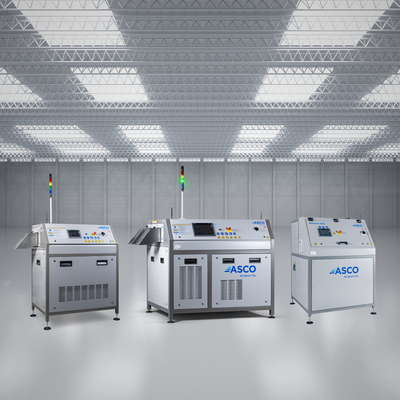
For rubber manufacturers with regular cleaning requirements, in-house dry ice production directly on site is a worthwhile investment. With ASCO dry ice pelletisers, the required dry ice can be produced fresh at any time and in the right quantities.
Thanks to the ASCO Carefree rental option, companies remain flexible: machine hire, service and optional CO₂ supply – all from a single source. This ensures that fresh dry ice is always available for cleaning, without reliance on external deliveries.


Comprehensive Solutions for Safety and Efficiency
In addition to blasting systems, ASCO also offers the right accessories – from CO₂ storage tanks and dry ice boxes to safety and measurement systems. This ensures that the entire CO₂ cycle is safe, efficient and sustainable – all from a single source.
Clean Moulds. Maximum Precision. Consistent Processes.
Whether injection moulds, presses or tools – with ASCO’s dry ice blasting process, manufacturers in the rubber industry ensure consistent product quality, shorter downtime and greater cost-effectiveness.




 +41 71 466 80 80
 info@ascoco2.com
 Newsletter
 LinkedIn