


Dry Ice Blasting
Innovative cleaning technology for industry, manufacturing and restoration – without water, chemicals or abrasives.
Dry Ice Blasting for Industry, Manufacturing and Restoration
Discover how dry ice blasting works, why the technology is so efficient and gentle on materials, and how businesses in industry, foundries, food processing, the automotive sector, aviation and restoration benefit from fast, dry and environmentally friendly cleaning processes.
What Is Dry Ice and Why Is It Suitable for Blasting?
Dry ice is solid carbon dioxide (CO₂) at –78.5 °C, which transitions directly from a solid to a gaseous state without leaving a liquid behind. These unique properties make dry ice ideal for dry ice blasting in industry, trade and food production.
During blasting, the pellets strike the surface and combine cold and kinetic energy to remove dirt, oil, grease, paint or resins. The CO₂ evaporates completely, leaving no residue – a clean, efficient and environmentally friendly process.
Why dry ice is perfect for dry ice blasting:
- Extreme cold (–78.5°C): Reliably blasts away dirt, grease, oil or deposits
- Sublimates without leaving residue: No moisture, no water residue on the surface
- Chemically neutral: Gentle on materials, no harsh chemicals required
- Gentle particle structure: No abrasion; even sensitive surfaces remain undamaged
- Environmentally friendly: CO₂ evaporates completely, no additional cleaning waste
Thanks to these unique properties, dry ice is ideal for industrial dry ice blasting, where gentle, efficient and residue-free cleaning is required.


How Does Dry Ice Blasting Work? – Explained Step by Step
Step 1: Feeding the dry ice pellets
The blasting machine is filled with pellets (1.7 mm or 3 mm). The machine automatically regulates the feed rate for the specific application and can be easily adjusted using a rotary control.
Step 2: Air pressure generates blasting speed
A powerful stream of compressed air (0–10 bar) transports the pellets through the hose to the blasting nozzle.
The pellets accelerate to over 300 m/s.
Step 3: Thermal shock effect
Upon impact with the surface, the –78.5 °C temperature creates a micro-cold shock.
The dirt contracts and detaches from the substrate.
Step 4: Cracking
The contraction of the coating causes cracks to form and the material becomes brittle due to the cold.
Step 5: Residue-free cleaning
The dry ice pellets striking the surface at high speed remove the loosened deposit. As the CO₂ evaporates completely, only the removed dirt particles remain. There is no blasting waste, no moisture and no chemical residues.
What Can Be Cleaned, and on Which Surfaces?
Dry ice blasting is suitable for a wide range of materials and surfaces – even where other methods fail or could damage components. Thanks to the gentle, non-abrasive cleaning principle, surfaces remain intact whilst even stubborn dirt is reliably removed.
Metal surfaces (steel, aluminium, cast iron)
Ideal for industrial use: removes oil, grease, release agents, rust protection or encrustations without roughening the surface.
Plastic and rubber moulds
Abrasion-free cleaning – perfect for moulds in the plastics and rubber industry, including moulds in operation (hot cleaning).
Electrical components & motors
Dry ice is not electrically conductive – therefore, control cabinets, circuit boards, motors and generators can be safely cleaned when de-energised.
Stone & masonry
Effective against algae, graffiti, mould, fire damage or soiling in the restoration sector.
Food contact surfaces
Deep cleaning of production facilities, conveyor belts or baking tins – efficient, residue-free and without the use of chemicals.
Stainless steel & sensitive machine components
Removes contaminants without damaging surfaces or affecting passive layers.
Painted or coated surfaces
With the correct jet setting, dirt can be removed without stripping the coating.
Operation and Requirements
The following requirements are essential for efficient operation:
- Compressed air supply (compressor or workshop air) with sufficient flow rate.
- Pellet supply – either delivered dry ice or in-house production
- Good ventilation of the work area
- CO₂ monitoring for safe working in confined spaces with poor ventilation
- Power supply – standard domestic power supply
ASCOJET blasting units are intuitive to use, feature digital controls, variable pellet consumption and a range of nozzles for every application. During installation, operators receive a comprehensive introduction to operation, safety and maintenance, enabling them to work efficiently and safely straight away. A properly prepared workstation not only ensures smooth operations but also consistent blasting results and an extended service life for the equipment.

Advantages of Dry Ice Blasting

Residue-free cleaning
No moisture, no sand, no chemicals – just the dirt needs to be removed.

Gentle on materials
Ideal for delicate surfaces such as moulds, electronics or painted surfaces.

Quick and efficient
Less downtime, less dismantling, immediate recommissioning.

Environmentally friendly
No wastewater, no chemicals, no abrasive waste.

Reduced downtime
Cleaning is often possible whilst the unit is installed – ideal for industrial facilities.

Safety
As it does not use solvents or hazardous chemicals, dry ice cleaning is safe for both people and the environment.




Your Own Dry Ice Production – Maximum Availability for Perfect Blasting
A reliable supply of dry ice is crucial for consistent cleaning quality. With your own dry ice production, you can ensure a constant supply of fresh blasting media, avoid delivery bottlenecks and reduce your operating costs in the long term.
Find out how you can make your blasting business more efficient, flexible and independent with in-house production.
Accessories for Efficient Dry Ice Blasting
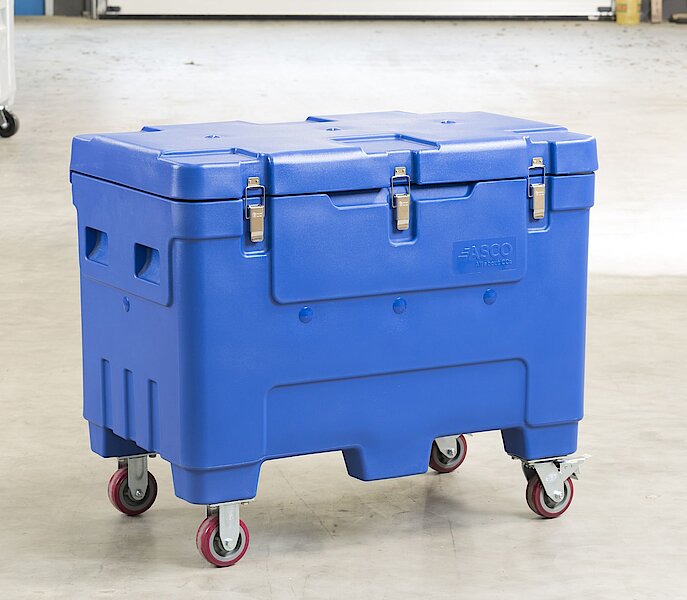
For professional dry ice blasting, it is not just the blasting machine that is crucial – the right accessories also ensure safe, efficient and smooth operations. These include, above all, high-quality dry ice boxes and containers that keep the ice fresh for a long time and simplify transport and handling. In addition, CO₂ detectors ensure reliable monitoring of the working environment and enhance safety during daily operations.
ASCO offers you a coordinated range of accessories that is precisely tailored to the requirements of modern blasting applications.

ASCO – Your Partner for The Entire CO₂ Value Chain
From CO₂ supply and dry ice production to recovery technologies: ASCO offers complete, seamlessly integrated solutions from a single source. With many years of experience, innovative technologies and a global service network, we reliably support companies on their journey towards greater efficiency, quality and sustainability. Get to know us and discover how ASCO can provide you with comprehensive support.
Dry Ice Blasting
Questions & Answers

What is dry ice blasting?
Dry ice blasting is a cleaning process in which dry ice pellets are fired at high speed onto surfaces to remove dirt, oil, grease or deposits – without the use of water or chemicals. Find out more here.
How does dry ice blasting work?
In dry ice cleaning, the pellets are accelerated to a speed of approximately 300 m/s using compressed air in the ASCO dry ice blasting machine and strike the object to be cleaned, where they create a localised thermal shock. This causes the coating to be removed to contract and detach from the base material. The resulting kinetic energy removes the coating. Upon impact, the dry ice pellets immediately turn into a gaseous state (sublimation), leaving a dry surface behind. Only the detached coating remains, and no blasting media needs to be disposed of. As the pellets have a hardness of only approx. 2 on the Mohs scale, the surface quality is preserved. More here
Which surfaces can be cleaned using dry ice blasting?
Machinery, tools, moulds, conveyor belts, paint booths and laboratory equipment for the industrial, food production, rubber, plastics and automotive sectors. Find out more here.
Is dry ice blasting abrasive?
No, dry ice is not abrasive and leaves no residue, so it won’t damage delicate surfaces. Find out more here.
What are the advantages of dry ice blasting?
Residue-free cleaning, minimal downtime, environmentally friendly, hygienic, suitable for food and pharmaceutical environments. Find out more here.
Can dry ice blasting be used for food?
Yes, it is possible to clean ovens, conveyor belts, silos and mixers to a hygienic standard. No residues or chemicals – making it suitable for food contact.
Which industries use dry ice blasting?
Food industry, pharmaceuticals, plastics, automotive, rubber, aerospace and industrial maintenance. Find out more here.
Is dry ice blasting environmentally friendly?
Yes, there are no chemical residues or water pollution – the process is sustainable and safe for staff.
Can dry ice blasting be harmful to health?
It is safe when used correctly with protective clothing and adequate ventilation. CO₂ detectors improve safety


 +41 71 466 80 80
 info@ascoco2.com
 Newsletter
 LinkedIn