

CO₂ shortages in industry – and why CO₂ recovery is becoming a strategic solution
Why CO₂ keeps running short
The key problem is that CO₂ used in industry is not a specifically produced raw material. In Europe, a significant proportion of the available CO₂ comes from ammonia production; in some markets, this share recently stood at around 45%. The gas is merely a by-product of this process and is only available when the main plant is in operation.
For CO₂ consumers, this means a massive dependence on industries whose production logic is entirely different. If an ammonia plant is shut down due to maintenance work, high energy prices or regulatory intervention, the CO₂ source disappears with it – often without warning. A particular problem is that these shutdowns tend to occur in clusters. Especially during the summer months, when the beverage and food industries’ demand for CO₂ rises seasonally, many plants go offline at the same time.
Added to this is the close link to the energy market. Rising gas prices in recent years have led numerous ammonia plants to temporarily scale back or completely halt production. As a result, not only did fertiliser production collapse, but so did the available supply of CO₂. This had significant consequences for CO₂ buyers: within a short space of time, prices multiplied; in some regions, they temporarily rose to several times the long-term average.
A market with a growing gap between supply and demand
What is particularly critical is that this situation is set to worsen further. Forecasts indicate that the freely available supply of CO₂ from traditional by-product sources could decline significantly in the coming years – by up to around 30% over the next decade. At the same time, industrial demand for CO₂ continues to grow, with annual growth rates of around 2%.
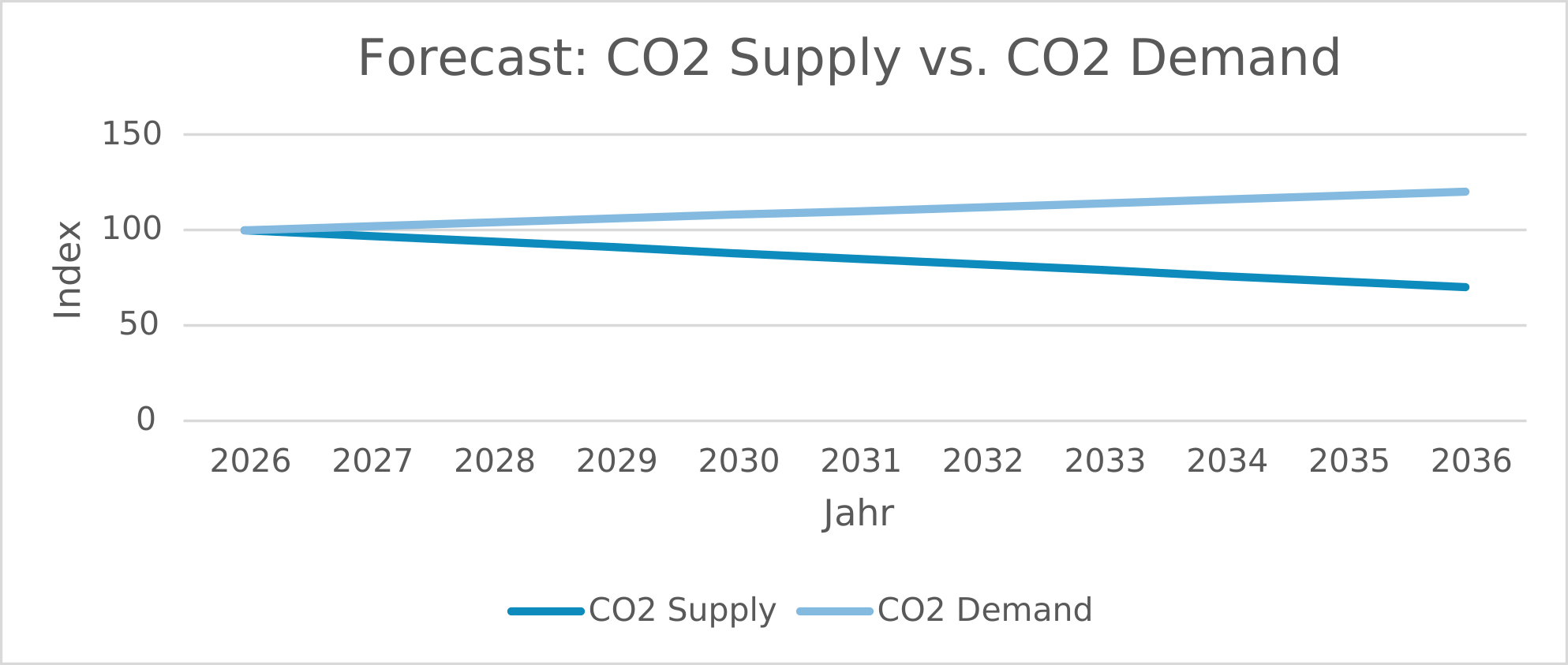
This opposing trend is leading to a structural imbalance: even without additional crises or geopolitical disruptions, supply is likely to become increasingly insufficient to reliably meet demand. For many companies, CO₂ is thus shifting from a standard operating resource to a genuine bottleneck.
When CO₂ is lacking, processes come to a standstill
The effects of CO₂ scarcity are particularly evident in everyday industrial operations where carbon dioxide is used directly as a process material, such as in the food and metal industries. In many applications, CO₂ is an integral part of the process – for example, as an inert gas, a reaction medium or for targeted process control. If the supply fails, these processes cannot simply be substituted or postponed, but must be scaled back or halted.
Sectors such as water treatment are also directly affected, as CO₂ is used there specifically for pH regulation. Downstream, shortages also impact applications that rely on CO₂ as a raw material, such as in the production of dry ice. This makes it clear: CO₂ is not a readily interchangeable auxiliary material, but a key factor in the stability of industrial processes.
CO₂ recovery: technology that ensures security of supply
Against this backdrop, CO₂ recovery plants are becoming increasingly important. From a technical perspective, they operate where CO₂ is produced anyway – for example, in exhaust gas streams from boilers, furnaces or process plants. The CO₂ contained therein is captured, purified and processed to a standard that allows for its reuse in operations.
The key advantage lies not only in the technology itself, but in the effect: companies become less dependent on external supply chains. Instead of buying CO₂ at high cost or hoping for uncertain delivery windows, a predictable, continuous source is available – right on their own site.
Circular economy with measurable benefits
CO₂ recovery plants also serve as a practical lever for industrial circular economy. Once captured, the CO₂ can be reused multiple times – for example, for cooling, cleaning, inert gas or carbonation. Every tonne of CO₂ reused replaces externally sourced gas whilst simultaneously reducing emissions.
For many companies, this pays off not only ecologically but also economically. In addition to more stable cost structures, CO₂ balances improve measurably, which is becoming increasingly relevant in the context of ESG reporting and regulatory requirements.
Even for companies that do not use the recovered CO₂ themselves, recovery can be economically worthwhile. If CO₂ is produced as a by-product in processes, it can be processed and specifically marketed to external buyers. In this way, a previously unused emission becomes an additional source of income. At the same time, this form of recovery helps to increase the overall supply of CO₂ and alleviate existing market bottlenecks – a benefit that extends beyond the company’s own operations.
Conclusion: CO₂ scarcity can be mitigated through technical means
CO₂ scarcity is not a short-term market problem, but the result of a system based on by-products and dependencies. Companies that continue to rely exclusively on external supply remain at the mercy of these risks.
CO₂ recovery plants offer an alternative approach. They transform emissions into a resource, stabilise supply and lay the foundations for a genuine CO₂ circular economy. Particularly in an environment of falling supply volumes and rising demand, this form of self-sufficiency is increasingly becoming a strategic competitive advantage.
You might also be interested in

CO2 recovery technology page


CO2 recovery from flue gas

CO2 recovery as a by-product

CO2 recovery from dry ice production
 +41 71 466 80 80
 info@ascoco2.com
 Newsletter
 LinkedIn