 Inquiries & Help


























Dry Ice for E-Commerce: Safe Shipping for Frozen and Sensitive Goods
Frozen or fresh products in online retail require an uninterrupted cold chain. For premium food, pharmaceuticals or other temperature-sensitive goods, dry ice has become an established professional solution. Frozen CO₂ keeps products safely frozen even under demanding conditions - without moisture and without external energy. In this guide, you will learn what dry ice is, how it can be used effectively in e-commerce, and what advantages and disadvantages it offers. You will also receive practical tips and a guide on how to successfully integrate dry ice into your shipping process.

What is dry ice and why is it relevant in e-commerce?
Dry ice is solid carbon dioxide (CO₂) at around –78.5 °C. One special feature is that when dry ice warms up, it changes directly from a solid to a gaseous state (sublimation) instead of melting. This means there is no meltwater left behind, and everything stays dry.
In online retail involving temperature-sensitive products - such as frozen foods, fresh delicacies, pharmaceuticals or certain cosmetics - the cold chain must be maintained continuously from the shipping centre to the customer’s doorstep. Without suitable cooling, temperature rise, quality loss or spoilage may occur. Dry ice enables extremely low and stable temperatures, ensuring that product freshness and safety are maintained throughout transport. Even with longer delivery times or summer heat, this cooling medium reliably maintains the required frozen temperature - without electricity or heavy refrigeration equipment. Because dry ice turns into gas without leaving residue, products and packaging stay dry, and condensation or moisture damage can be avoided.
In short, dry ice provides the cooling power needed for the safe shipping of sensitive goods. In e-commerce, it has become an essential cooling medium for protecting quality and strengthening customer trust in chilled online orders.
Applications: Where dry ice proves its value in online retail
Dry ice is used wherever uninterrupted cooling is essential. Typical examples in e-commerce include:
- • Food & frozen products: Fresh meat, fish, seafood, ice cream and similar items can be shipped reliably in frozen condition with dry ice. Even with overnight express delivery, the goods remain deeply frozen and arrive in perfect condition.
- • Pharma & healthcare: Medicines and vaccines often require continuous cooling. Dry ice enables shipping temperatures far below freezing (down to around –70 °C), as required for certain vaccines. Laboratory samples or biotech products can also be kept safely cold in this way without losing effectiveness.
- • Specialty and premium products: Sensitive delicacies (such as premium chocolate in summer), frozen pet food or certain chemical products benefit from the constant cooling performance of dry ice. They reach the recipient intact and in top quality - regardless of outside temperature or shipping distance.
- • Cosmetics & organics: High-quality cosmetic products (for example natural creams) or temperature-sensitive organic materials are also shipped with dry ice to avoid changes caused by heat. This helps them maintain stability and quality throughout delivery.
These examples show that almost all temperature-sensitive products can be shipped reliably with dry ice - even over long distances or internationally. The cold chain remains stable for longer, allowing even distant customers to be supplied safely.
Dry ice vs. ice packs & gel packs: the key differences
Ice packs and gel packs are common standard solutions for chilled shipping. Dry ice, by contrast, is the preferred option for more demanding scenarios where lower temperatures and longer cooling times are required. A compact comparison:
Criterion | Dry Ice | Ice Packs & Gel Packs |
|---|---|---|
| Temperature Level | Very cold (frozen temperatures down to around –78 °C) - reliably keeps frozen goods frozen. | Moderately cold (only refrigerator temperatures just above 0 °C) - no frozen shipping possible. |
| Cooling Performance & Duration | High cooling reserve - even longer transport times (several days) can be bridged if enough dry ice is used. | Limited cooling effect - stable only for short periods (hours); longer transit times without re-cooling are risky. |
| Moisture & Waste | Sublimates without residue - no meltwater, goods and packaging stay dry; no disposal required (CO₂ escapes as gas). | Melts into liquid - moisture forms inside the packaging (product & carton can become wet); empty cooling packs create waste (plastic) or logistical effort for return shipping. |
In simple cases and for short cooling durations, conventional ice packs or gel packs may be sufficient. However, as soon as true frozen shipping, longer transit times or high ambient temperatures come into play, dry ice is the more reliable solution. With its superior performance, it covers even the most demanding cold shipping requirements and provides a critical safety buffer against temperature fluctuations.
Packaging, storage and shipping: integrating dry ice successfully
How can dry ice be integrated smoothly into the shipping process? The good news is that with the right planning, shipping with dry ice is now a well-established standard process.
Selecting the right insulated packaging
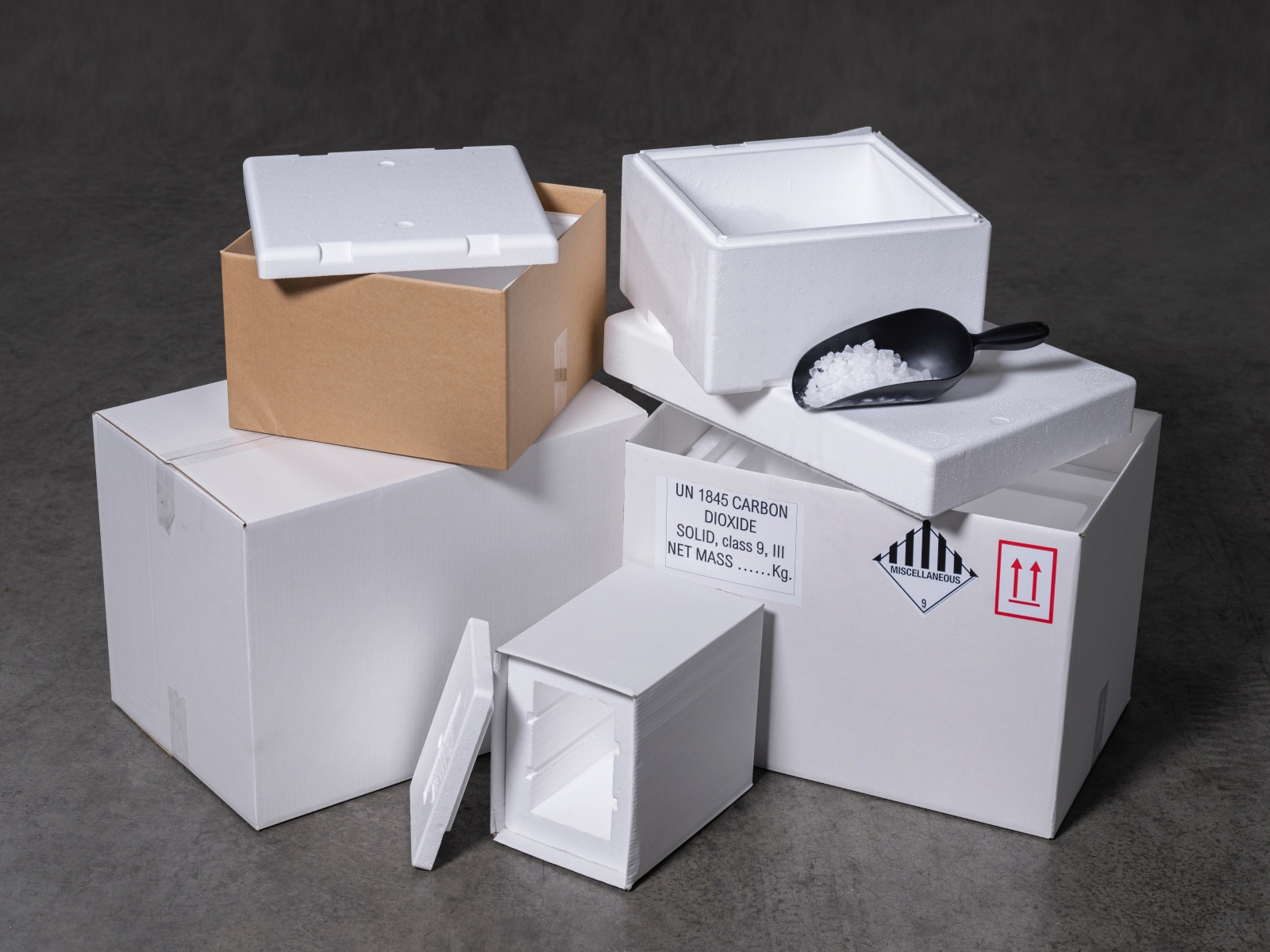
The first step is choosing suitable insulated packaging. Proven options include EPS (polystyrene) or rigid PUR foam thermal boxes placed inside sturdy outer cartons. These minimise heat ingress from outside and ensure that the cooling performance of the dry ice can be fully utilised. Whether it is a small box for dessert deliveries or a large container for palletised goods, size and format should be adapted to shipping volume.
It is important that the packaging can withstand extreme cold (down to –80 °C) without becoming brittle. In addition, CO₂ gas must be able to escape from the box in a controlled manner. Packaging must never be completely airtight, otherwise dangerous pressure could build up. Modern thermal boxes are designed accordingly so that the gas produced can escape automatically (for example through small ventilation openings or lids that are not fully sealed).
Storage & handling in the shipping centre
In day-to-day operations, dry ice has a few special characteristics that can be managed well through clearly defined processes:
- • Correct storage: Store dry ice in special, well-insulated containers (for example thick polystyrene boxes or thermal containers) to minimise losses through sublimation. Just-in-time delivery or production is ideal so that no excess dry ice evaporates unused. The storage area should be cool and well ventilated to prevent CO₂ accumulation.
- • Integration into the packing process: During packing, shipping staff place dry ice - usually in the form of pellets or nuggets - into the thermal box together with the goods in the correct quantity. Important: Only handle it with protective gloves or suitable tools to avoid cold burns. It is common practice to wrap the dry ice in paper or place it in bags so that the goods do not lie directly against the -78 °C ice (protection against freezer burn).
- • Training & processes: Employees must be trained in the safe handling of dry ice. This includes awareness of CO₂ hazards in enclosed spaces, the correct use of protective equipment and proper package labelling. Standardised processes (for example packing instructions) ensure that every step is carried out correctly. This keeps the additional effort to a minimum.
In practice, the following becomes clear: with well-designed processes, dry ice can be used smoothly without significantly slowing down the shipping process. Once routines are established, packing times are hardly longer than with conventional cooling methods - while cooling performance is significantly better.
Take shipping partners & regulations into account
Dry ice is classified as Class 9 dangerous goods (UN 1845). Nevertheless, shipping it with most parcel services and logistics providers is straightforward because the requirements are standardised:
- • Label packages: Every shipment containing dry ice must visibly carry a dangerous goods label (Class 9 stripe pattern). In addition, the wording “UN 1845 - Carbon dioxide, solid (dry ice)” and the net weight of the dry ice used must be shown on the shipping label.
- • Comply with carrier requirements: Many shipping providers have specific guidelines - such as a maximum quantity of dry ice per package or special labelling rules. These points should be clarified with the provider in advance and stored in the shipping software. For international shipments (especially air freight), additional rules may apply (IATA regulations).
- • Ventilated transport: Most service providers require - and this is in line with safety rules anyway - that dry ice packages are not hermetically sealed and are transported in ventilated vehicles.
If these points are taken into account, shipping with dry ice becomes a fixed and safe process. The additional requirements quickly become a routine part of logistics once cold shipping is established.
Plan transit times carefully
The shorter the delivery time, the less dry ice is required. It is therefore worth using fast shipping methods (for example overnight express) and scheduling shipping days so that unnecessary delays are avoided (for example not leaving chilled parcels in transit over a weekend). Well-planned shipping supports a stable cold chain and also helps optimise dry ice consumption.
Risks and limitations: what to keep in mind when using dry ice
Dry ice is an effective cooling medium, but due to its temperature of around –78.5 °C and its sublimation into gaseous CO₂, it also presents specific risks. These primarily include cold burns from direct skin contact, embrittlement of unsuitable plastics or seals, and CO₂ accumulation in poorly ventilated areas, which can become a safety issue especially in small rooms, vehicles or storage spaces.
In addition, not every product tolerates immediate proximity to dry ice. Sensitive goods can be damaged by excessively low temperatures if the arrangement inside the package is not coordinated properly. Precision is also required in process terms because cooling performance is not static but depends on time, packaging quality, ambient temperature and the quantity used. Anyone working with dry ice must therefore not only achieve the desired temperature but also plan realistically for sublimation losses, transit times and safety margins.
It is also essential to comply with transport and dangerous goods requirements, as incorrect declaration, unsuitable packaging or poor handling can lead to safety issues and logistical disruption. At the same time, practical experience shows that with suitable equipment, clear work instructions and trained personnel, dry ice can be handled well and safely integrated into professional shipping processes.
Step by step: how to get started with dry ice shipping
Anyone introducing dry ice into shipping for the first time should proceed in a structured way. A proven guide for managing directors and logistics managers:
Step 1: Define the packaging concept - Choose suitable thermal packaging (for example a polystyrene box with an outer carton) that can withstand temperatures below –70 °C and is ventilated. Define where the dry ice will be placed inside the package (for example above the goods with an intermediate layer). Make sure that the product and the dry ice are well matched (no direct contact, no unwanted side effects).
Step 2: Carry out test shipments - Start with pilot packages: send several trial shipments with dry ice (for example internally to colleagues or test customers). Monitor the temperature inside the package using data loggers or thermometers to ensure the cold chain is maintained. This gives you practical data on the optimum dry ice quantity and packaging for your product and shipping route.
Step 3: Verify and adjust the cooling concept - Based on the tests, you will know roughly how much dry ice is needed per shipment. Make adjustments where necessary (such as additional insulation or a different placement of the ice) and always include a safety margin so that sufficient cooling reserve is available even in the event of unexpected delays.
Step 4: Coordinate processes and service providers - Clarify all requirements with the shipping provider (dangerous goods labelling, special collection conditions, and any maximum dry ice quantity permitted per package) and align your internal processes accordingly. Ensure that dry ice is delivered or produced just in time in order to keep losses low. Provide the necessary equipment and materials at the packing station (gloves, labels, tools).
Step 5: Train the team and go live - Train all involved employees thoroughly in safety, handling and packaging guidelines. Create easy-to-understand work instructions for every step, from storage through to handover to the parcel service. Then start live operation with dry ice and continuously review the processes (for example by evaluating temperature loggers and gathering customer feedback) in order to keep optimising the cold chain.
This structured approach allows dry ice shipping to be introduced in a controlled and efficient way. Initial challenges can be identified and resolved during the test phase before full operations are scaled up.
Scaling up: in-house dry ice supply & automation
As shipping volume grows, dry ice becomes a strategic scaling factor. Beyond a certain point, it makes sense to consider in-house dry ice production. In-house production offers clear benefits: it secures supply (independence from external deliveries) and provides fresh dry ice with maximum cooling performance exactly when it is needed. In addition, the cost per shipment can be reduced significantly at high throughput because intermediaries and delivery charges are eliminated. In such cases, the initial investment often pays for itself relatively quickly.
At the same time, automation comes into focus as volumes increase. Modern systems make it possible to produce, portion and package dry ice directly in the shipping centre. For example, the cooling medium can be automatically filled into film bags and sealed before it is placed in the parcel. This increases efficiency and repeatability: every carton receives exactly the intended quantity, manual effort decreases, and safety improves - no unnecessary handling, no variability. In practice, this results in higher throughput, stable processes and a flexible infrastructure that guarantees reliable cold shipping even as order volumes rise.
Conclusion: turning dry ice into a competitive advantage
Dry ice is a powerful and established tool for demanding cold shipping applications. It enables stable frozen supply chains, protects product quality and can be integrated efficiently into existing processes with the right preparation. Dry ice reaches its full potential when combined with careful planning, reliable supply and, where required, automation.