Inquiries & Help
























Storing Dry Ice: What to look out for?
Dry ice is an indispensable cooling medium in many sectors. Whether in food and pharmaceutical logistics, in the event sector, in industry or when transporting temperature-sensitive products - its extremely low temperature of -78.5 °C ensures reliable and residue-free cooling. Correct storage plays a decisive role in ensuring that dry ice can develop its full effect and no safety risks arise. But how is dry ice stored properly? What conditions must be met and why is inadequate storage not only inefficient but also dangerous?
How dry ice behaves during storage
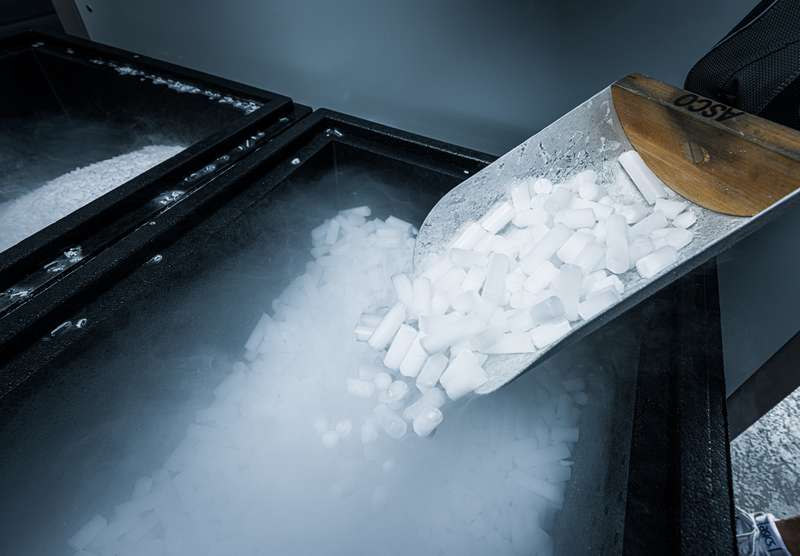
Unlike conventional water ice, dry ice does not melt but sublimates. This means that it changes directly from a solid to a gaseous state. This process begins immediately after production and cannot be completely stopped, but it can be significantly slowed down if the right conditions are created. The better the dry ice is insulated and the more the external heating is minimized, the lower the so-called sublimation rate and the longer the material remains usable.
Requirements for suitable storage containers
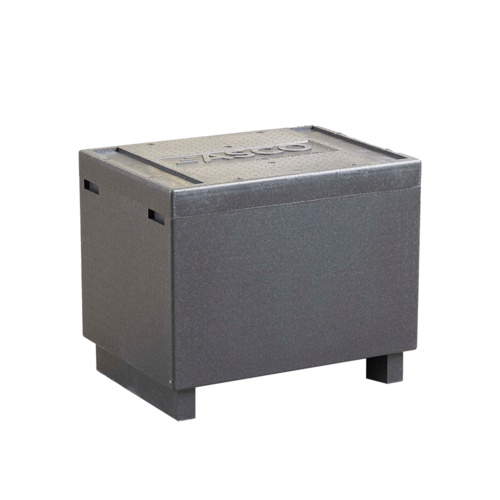
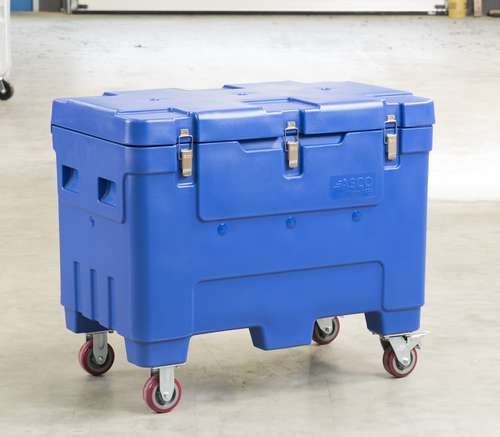
Since carbon dioxide is released during sublimation, storage containers for dry ice must never be completely sealed airtight. Otherwise, the gas produced could create dangerous excess pressure. Suitable containers are therefore specially insulated dry ice boxes or containers that protect the material from heat while allowing the gas to escape in a controlled manner. These containers are often made of highly insulating materials such as EPP or PE and are designed to maintain the internal temperature for as long as possible. Filling the container as completely as possible can help to reduce the loss rate, as there is less air inside that could promote the sublimation process.
Optimal storage conditions for a long shelf life
Dry ice should always be stored in a cool, dry place, away from direct sunlight or heat sources. A closed room without windows is ideal, as this minimizes temperature fluctuations. Important: The room must still be well ventilated so that the CO₂ released does not accumulate and cause a risk of suffocation. More on this in the next section.
The shape of the dry ice also affects its shelf life. Large blocks sublimate more slowly than small pellets because they have a smaller surface area in relation to their volume. The cooling capacity, e.g., for refrigerated transport, is maintained for all forms of dry ice, even during prolonged storage. However, in dry ice blasting applications where small pellets are used, the quality of the blasting result can be impaired during prolonged storage. Therefore, dry ice that is as fresh as possible should be used for blasting.
Safety aspects for the storage of dry ice
Since dry ice is extremely cold at a temperature of –78.5 °C, there is a risk of frostbite if it comes into direct contact with the skin. Protective measures such as wearing insulated gloves are therefore essential. In addition, the material should never be stored in airtight rooms, as the carbon dioxide gas produced can accumulate in closed areas and, at high concentrations, oxygen displacement becomes a hazard. There is a particular risk of CO₂ accumulation in small, unventilated rooms or vehicles, which is why it should always be stored in well-ventilated areas. Dry ice containers must not be stored in completely closed cars, as there is also a risk of suffocation there.
How long can dry ice be stored?
The shelf life of dry ice varies depending on storage conditions and container type. High-quality industrial boxes often achieve a sublimation rate of just a few percent per day, while poorly insulated or open storage causes significantly higher losses. Anyone who needs dry ice over a longer period of time must therefore either obtain regular supplies or opt for an alternative that can meet their needs more flexibly.
Storage options from ASCO - optimum solutions for all requirements
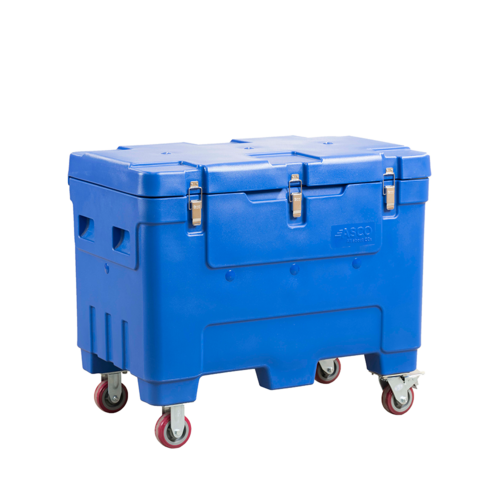
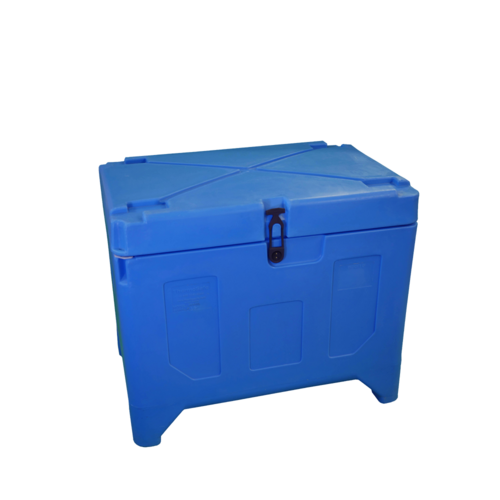
ASCO offers a wide range of specially developed storage solutions for the safe and efficient storage of dry ice. The insulated dry ice boxes and containers are designed to significantly reduce the sublimation rate, thereby ensuring a longer shelf life for the material. High-quality insulation materials such as EPP or PE keep the internal temperature as stable as possible, minimizing daily dry ice loss. The containers are available in various sizes – from compact boxes for smaller quantities to large-volume containers for industrial applications.
Another advantage is their practical handling: many models feature ergonomic lid systems, easy-to-clean interiors, and robust construction that enables safe transport within operational processes. For mobile use, for example in logistics or catering, ASCO offers solutions that allow easy integration into existing transport processes without compromising on efficiency and safety. Companies thus benefit from reliable storage technology that is tailored to different quantity requirements and at the same time helps to reduce losses.
Conclusion
Proper storage of dry ice is crucial in order to reliably utilize its cooling capacity and minimize losses due to sublimation. Understanding the physical properties of dry ice, creating suitable storage conditions, and using high-quality container systems significantly increases efficiency in daily use. With ASCO's specially developed dry ice boxes and containers, companies receive practical solutions that are tailored to different storage requirements and ensure maximum shelf life. This not only keeps dry ice usable for longer, but also allows it to be used more economically – a decisive advantage for numerous industries and applications.