Inquiries & Help





















What factors influence the cleaning results of dry ice blasting?
Dry ice blasting has become established in industrial cleaning because it cleans surfaces quickly, dry and without residue – without dismantling and without additional chemicals. Whether the desired result is achieved depends primarily on how the process is prepared and operated. Anyone who understands and correctly sets up the interaction between dry ice quality, nozzle and compressed air achieves consistently better results while reducing consumption and downtime. This article explains the most important influencing factors – a compact, practice‑oriented guide.

Operating principle – short and clear
Before looking at specific settings, it is worth understanding the underlying principle. During dry ice blasting, CO₂ pellets hit the contamination at high speed (kinetic energy). The extreme cold of −78.5 °C weakens the adhesion of the coating (thermal shock), and the pellets immediately sublimate upon impact, expanding rapidly. As a result, the loosened contamination lifts off, leaving a dry and clean surface without secondary waste. Limits are reached where contamination adheres too strongly or is oxidised, such as rust.
Why preparation determines the result
In practice, it becomes clear again and again: the blasting result is not created on the surface alone, but already during planning. Anyone who clearly defines the target condition, correctly assesses material and contamination and checks the available infrastructure has completed half the work before the first blast. This also includes clarifying dry ice logistics, having suitable nozzles available and realistically assessing the available compressed air – including line cross‑sections, drying and filtration.
Dry ice quality – freshness is a performance factorNot all dry ice is created equal: Fresh pellets transfer more kinetic energy and intensify the thermal shock. Older dry ice pellets (older than 2 days or—depending on storage conditions) absorb a significant amount of ambient moisture; they appear glassy, partially collapse, and are no longer clearly recognizable as pellets. In the blasting machine’s hopper, they tend to clump together and cause blockages at the inlet of the distribution unit. Moisture also settles on the surface of the object being cleaned—the surface becomes wet. The cleaning jet stalls and becomes uneven. This leads to an irregular cleaning result and wasted time.
The solutions are simple: short transport distances, insulated boxes, efficient processing, and consistent dry-blowing before starting. Those who clean regularly also benefit from in-house production: fresh, dense dry ice pellets are available as needed, logistics dependencies and losses decrease, and reproducibility increases.
The Right Nozzle – Shaping the Spray Pattern
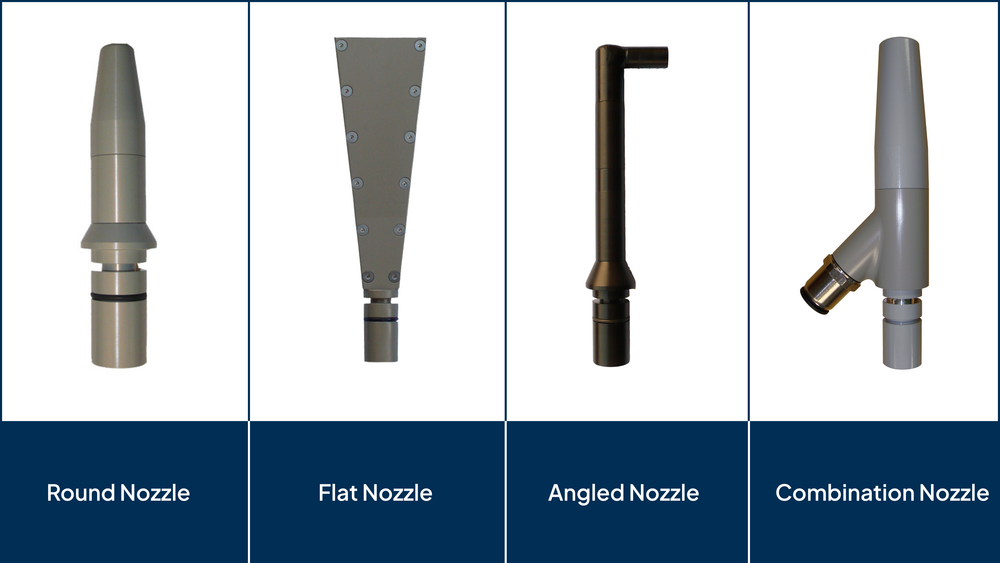
The nozzle you choose determines the focus, energy density, and air requirement—the following options have proven effective in practice:
- Round nozzle (conical acceleration): It concentrates the jet energy and produces the highest localized effect—ideal for selectively removing stubborn deposits. Its strength lies in the maximum energy density over a small area and the clean transitions. Depending on the task, openings such as 10/11/13 mm are used; for particularly delicate surfaces, plastic variants are available.
- Flat nozzle: It distributes the energy over a wider area and ensures even, smooth transitions on large, flat surfaces. The spot power decreases, while the surface coverage increases.
- Angled nozzle: When working with complex geometries or at a distance, this nozzle facilitates access. It offers less control over the spray pattern than round or flat nozzles, making it suitable for selective applications—where accessibility is more important than perfect line definition. It is also ideal for small opening sizes, particularly in the plastics industry.
- Combination nozzle (Venturi principle): This allows for the addition of fine abrasive media (up to approx. 0.3 mm) as needed to break through localized resistance when dry ice blasting alone is insufficient. It is not intended as a continuous sandblasting solution; its strength lies in providing targeted “boosts” without compromising the nature of dry ice blasting.
Practical Tip: Test the nozzles on site—vary the material, geometry, and coating. A direct comparison will reveal the best choice for the desired blasting result.
Compressed Air – Quality, Volume, and the Right Pressure
Compressed air is the medium that drives the process and is often the limiting factor. Clean, dry air with a low pressure dew point prevents icing, abrasive breakage, and unstable blast patterns. The flow rate is equally important: The equipment, nozzle, and desired performance determine how much free air (m³/min) must actually be delivered under load. If volume is insufficient, particle velocity drops—and the effect diminishes noticeably. Only when the air’s quality and quantity are right is it worthwhile to increase the working pressure: Higher pressure increases pellet velocity but only achieves its full effect in a stable air environment. A practical reference point from the plastics industry: 2.5–3 bar is often sufficient for removing release agents; for large-area cleaning or stubborn layers, higher pressures and larger nozzles are advisable. And during breaks: use up the ice, briefly blow dry—this keeps the system clear.
Fine-Tuning – Small Adjustments with a Big Impact
Once you have the ice, nozzle, and compressed air under control, fine-tuning determines the speed and gentleness of the process. A slightly warmed surface intensifies the relative thermal shock and accelerates the removal of release agents, paint, or adhesive residues. The jet distance and angle determine the energy density: 90° to the object being blasted is ideal. Pellet dosage also needs to be carefully controlled—more is not automatically better. Often, the balance between pellet quantity and air velocity delivers the highest area coverage with moderate consumption. And finally, the match between material and coating: Dry ice works particularly well when coatings react to temperature differences or impact (e.g., release agents, plastics, and food residues, PU foam, adhesives, wax, bitumen). For firmly adhered oxides, the optional abrasive additive via the combination nozzle can provide the necessary extra power.
What this means for your daily operations:
Those who view dry ice blasting as a process rather than a one-off measure get more out of it: more consistent results, lower ice consumption, shorter setup times, and less downtime. The sequence is logical and practical: define the target, assess the object, secure the air side, ensure a fresh supply of ice, test the nozzle, and fine-tune the parameters on the object. This is how a technology becomes a reliable standard in industrial cleaning—from mold maintenance to equipment cleaning.
How ASCO supports you: We won’t leave you on your own along the way. ASCO actively supports you—from the initial assessment directly at your facility, through the air-side audit (quality, flow rate, piping), to nozzle and parameter tests under real-world conditions. Our experts bring years of expertise from a wide range of industries and work with you to develop a setup that fits your application and resources—including training and practical optimization during ongoing operations.